
Scope and disclaimer. This guide to affiliate disclosure for blogs covers the U.S. Amazon Associates program and U.S. Federal Trade Commission (FTC) guidance only. Rules for Amazon programs in other countries, and for other regulators, were not reviewed. This is general information, not legal or financial advice. For decisions about your own situation, talk to a qualified professional.
Two sources, two purposes. If you earn commissions through Amazon links, two different things apply. One is your contract with Amazon. The other is guidance from the FTC about endorsements. They overlap, but neither replaces the other.
What Amazon Associates requires
The disclosure statement
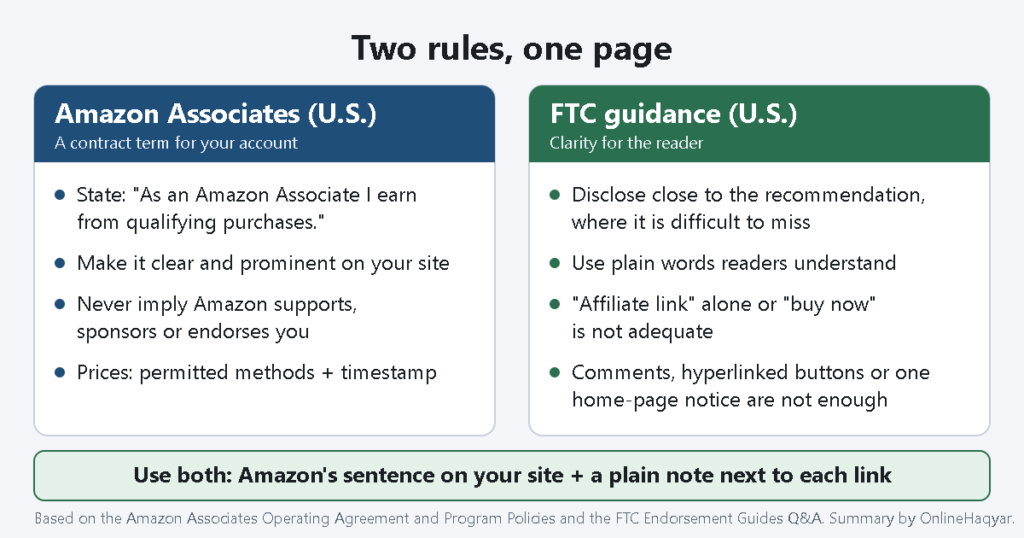
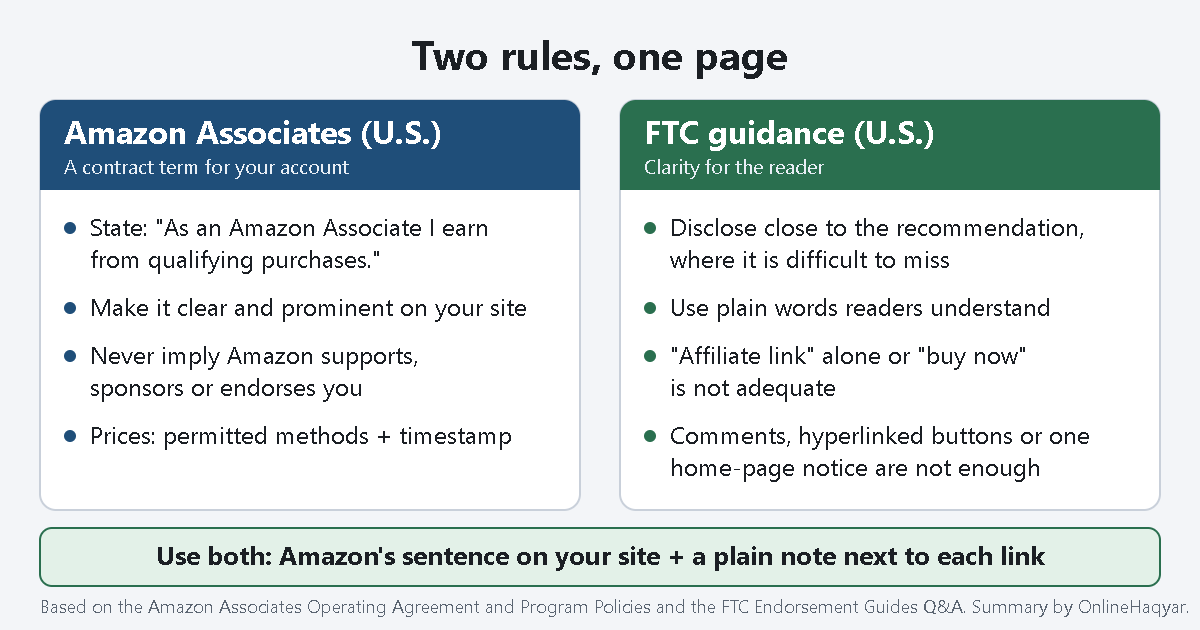
The Amazon Associates Operating Agreement (page dated October 15, 2025) says you “must clearly and prominently state the following, or any substantially similar statement” that was “previously allowed under this Agreement.” The statement is: “As an Amazon Associate I earn from qualifying purchases.” It applies “on your Site or any other location where Amazon may authorize your display or other use of Program Content.”
What this does and does not mean: Amazon allows the standard sentence or a substantially similar statement that was previously allowed under the agreement. The page does not list which variants qualify, so this guide cannot tell you whether a given rewording is acceptable (unverified). The simplest safe choice is to use the standard sentence as written. If you want different wording, check with Amazon rather than assuming.
Other Amazon rules to know
- Except for this disclosure, “and other than as required by applicable law,” you may not make public communications about the agreement or your participation without Amazon’s advance written permission. You also may not misrepresent or embellish the relationship, including by implying Amazon supports, sponsors or endorses you.
- The Program Policies (page “Updated: April 14, 2026”) require “disclosing on your Site accurately and adequately and otherwise satisfying applicable legal requirements” and refer to the U.S. FTC endorsement Guides.
- Your site “may only show prices and availability if” Amazon serves the link or you obtain the data “via Creators API or PA API,” according to the Program Policies. If you display such data, the policies require a date/time stamp next to it and this disclaimer: “Product prices and availability are accurate as of the date/time indicated and are subject to change.” It may sit next to the price or be reached by a link or pop-up.
- Email and SMS messages containing special links must be solicited (opted in). Offline promotion is not allowed, per the Program Policies.
- The Influencer Program Policy gives “#Ad” or “#Sponsored” as examples of labeling, relevant if you promote on social media.
What the FTC guidance says
This is general U.S. guidance for people who endorse products, not Amazon’s wording.
Placement
The FTC says a disclosure “should be placed where it easily catches consumers’ attention and is difficult to miss,” and is more likely to be seen when very close to the endorsement. It warns that if the review and the link “are separated, readers may not make the connection.” A disclosure in the comments, behind a hyperlinked button, or in a single home-page notice is not enough. Its influencer guide adds that disclosures are likely to be missed on an About page, at the end of posts, or where a click on “more” is needed.
Wording
The FTC suggests a line like “I get commissions for purchases made through links in this post.” It says “affiliate link” on its own and “buy now” buttons are not adequate, “paid link” right next to an affiliate link is adequate, and “commissionable link” is probably not clear. Clarity is judged from the view of “reasonable consumers,” not the blogger.
Affiliate disclosure for blogs: using both on one page
- Place Amazon’s disclosure statement where it is clear and prominent on your site.
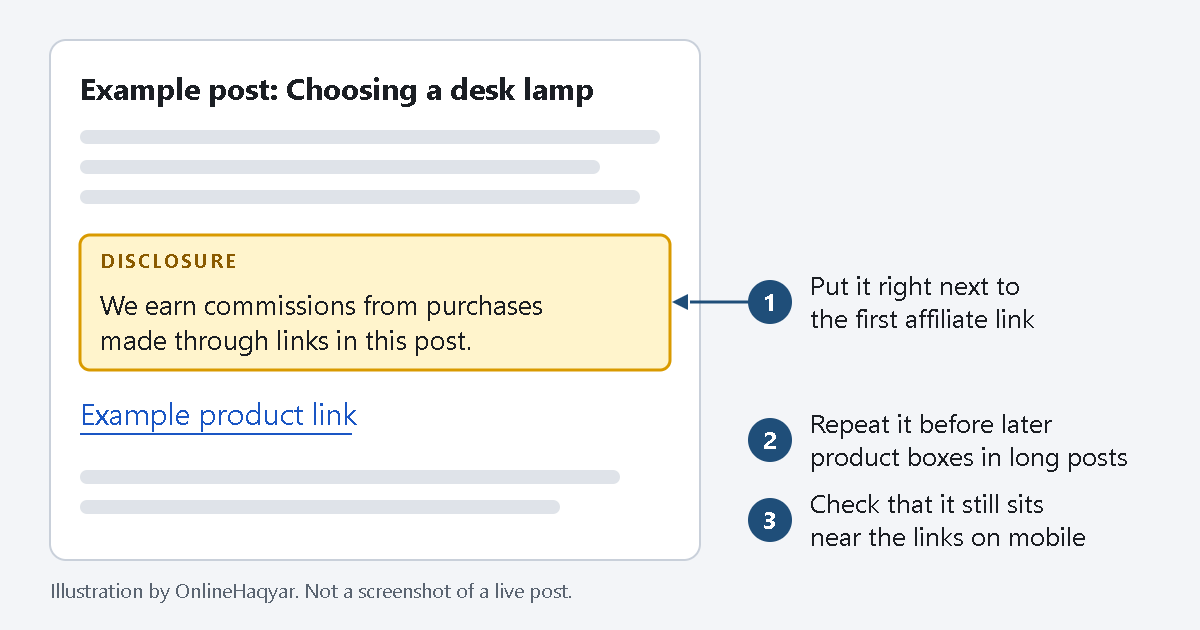
- Add a plain sentence next to the first affiliate link in each post, such as “We earn commissions from purchases made through links in this post.” (Author’s suggested wording, modeled on the FTC example. Not an FTC or Amazon quotation.)
- Repeat it before later product boxes in long posts.
- Check the mobile layout, so the sentence still sits near the links.
- Skip prices unless you use an Amazon-permitted method with the timestamp and disclaimer.
Common mistakes
- Footer-only disclosure.
- “Affiliate link” as the only label.
- Hard-coded prices copied from a screenshot.
- Implying a special partnership or endorsement from Amazon.
- Assuming a past post’s disclosure covers a new one.
FAQs
Does Amazon’s sentence satisfy the FTC? The sources reviewed do not say it does. Amazon’s text is a contract term. The FTC looks at clarity and placement for the reader, so add a sentence near the link.
Can I change Amazon’s wording? Amazon permits “any substantially similar statement previously allowed under this Agreement.” Which changes qualify is unverified here. Use the standard sentence unless Amazon confirms a variant.
Do I disclose free products? The FTC says the FTC Act applies if you receive free products or perks with the expectation that you will promote them.
Does this apply outside the U.S.? This guide covers only the U.S. Amazon Associates program and U.S. FTC guidance. Other countries were not reviewed.
Conclusion
A good affiliate disclosure for blogs uses Amazon’s required statement for your account and adds a short plain-language disclosure next to your links for readers. For this site’s own policy, see our site disclosure policy. This is general information, not legal or financial advice.
Sources
- Amazon Associates Operating Agreement (October 15, 2025)
- Amazon Associates Program Policies (April 14, 2026)
- FTC, Endorsement Guides: What People Are Asking (last modified July 15, 2025)
- FTC, Disclosures 101 for Social Media Influencers (last modified December 3, 2024)