

Last updated: November 2026. General information for US cardholders, not legal or financial advice. Your card agreement may give more detail or extra options. No affiliate links.
Holiday shopping means more transactions, and more chances of a duplicate charge, a wrong amount or something you don’t recognise. With Black Friday on November 27, 2026 and Cyber Monday right after, December statements are when many of these mistakes show up. The good news for US cardholders: if you need to dispute a credit card charge, there is a formal process for billing errors, with deadlines your card company has to meet too.
This guide walks through six steps to dispute a credit card charge, includes a sample letter, and explains the separate rules for unauthorized charges and faulty goods.
Step 1: Check your statement before you dispute a credit card charge
Official guidance (CFPB): The Consumer Financial Protection Bureau suggests comparing your starting balance with last month’s bill and looking for charges you don’t recognise, including “add-on” or optional fee-based products you didn’t mean to buy. (CFPB guide, PDF)
Author’s tip: Before you call, check whether an unfamiliar name is simply a merchant’s billing name. Match the date and amount against your receipts and order emails. A “mystery” charge is sometimes a familiar shop billing under a parent company’s name.
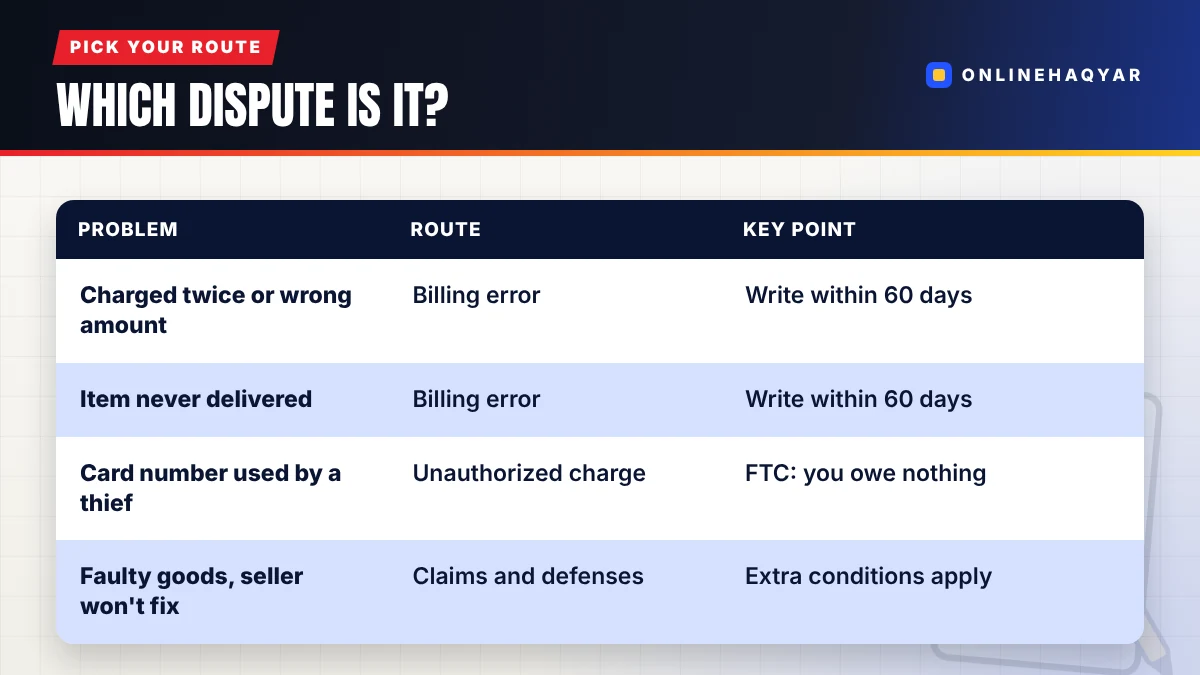
Author’s analysis: Look out for the classic holiday errors: the same order charged twice after a checkout page froze, a pre-authorisation that never dropped off, a price that doesn’t match the deal you saw, or an order that was cancelled but still billed.
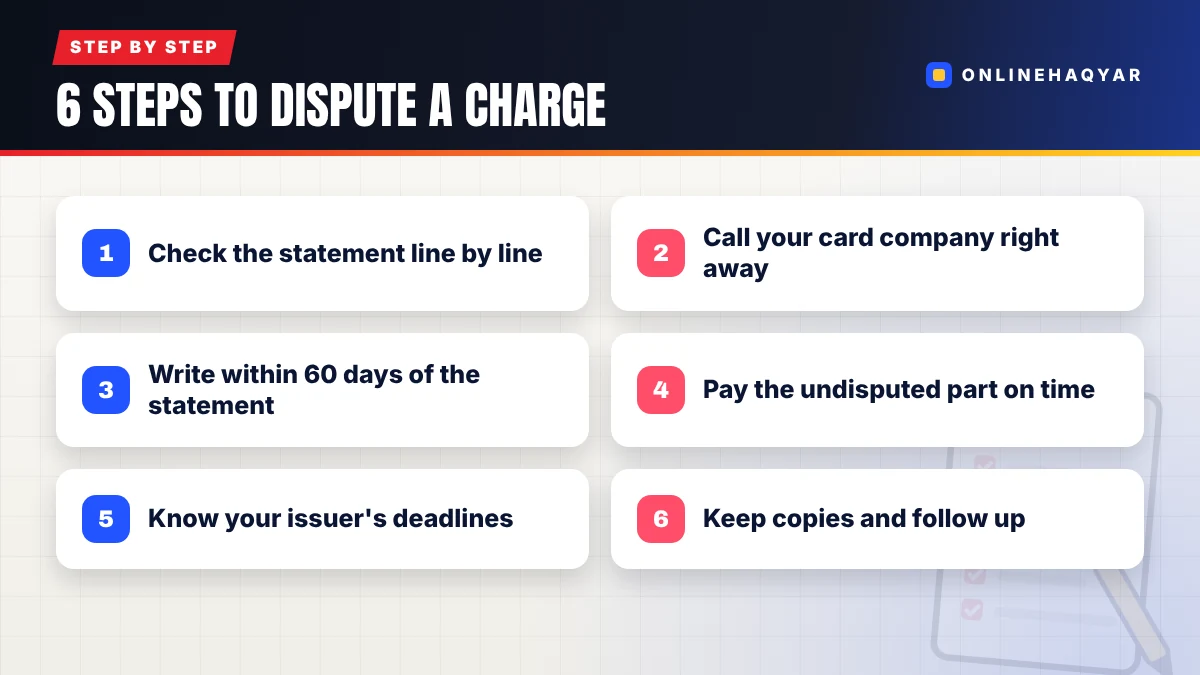
Step 2: Contact your card company right away
Official guidance (CFPB): Call your card company as soon as you notice the problem, and check your card agreement. (CFPB: How do I dispute a charge?)
Official guidance (CFPB guide): You can explain the problem to customer service by phone, or file a dispute online if your issuer offers that.
Author’s tip: Note the date, time and name of the person you spoke to. If the issuer fixes the problem on the call, great. If not, the next step is what protects your rights.
Step 3: Send a written notice within 60 days
This is the step people skip, and it matters most when you dispute a credit card charge that the issuer doesn’t fix straight away.
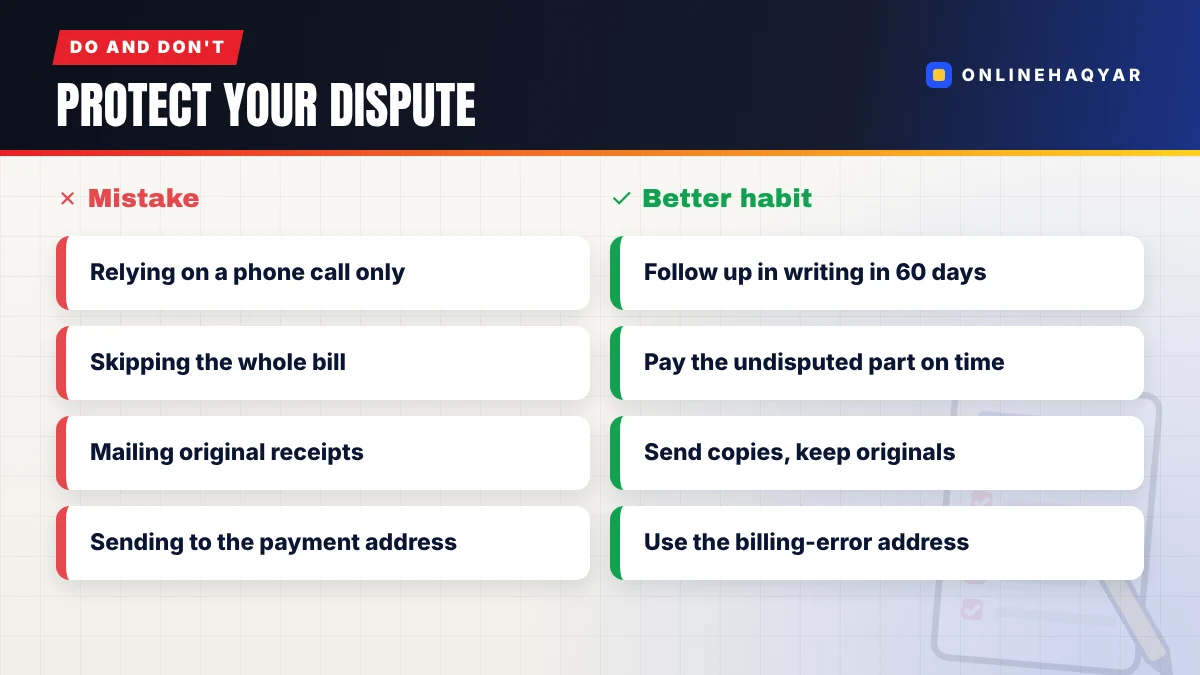
Official guidance (CFPB): To use the billing-error dispute process, send a written notice within 60 calendar days after the charge appeared on your statement. Send it to the address your bill gives for billing errors, which may be different from the address for payments. Keep a copy.
What to include in your letter
Official guidance (CFPB guide):
- your name and address;
- your account number;
- a clear explanation of what you think is wrong and why.
Sample letter
This is our own template, not an official CFPB form. Replace the bracketed parts with your details.
[Your name], [Your address], [Date]
To: [Card company], billing-error address from your statement
Re: Billing error on account ending [last 4 digits]
I am writing to dispute a charge of $[amount] to [merchant] dated [date], shown on my statement dated [statement date]. This charge is an error because [for example: I was charged twice for the same order / I did not receive the item / the amount differs from my receipt].
Please correct this error and remove any related finance charges. Copies of my [receipt / order confirmation] are enclosed.
Sincerely, [Signature]
Author’s tip: Send copies, never originals. Tracked mail gives you proof of the date you sent it.
Step 4: Keep paying the rest of your bill
Official guidance (CFPB guide): While the card company investigates, you don’t have to pay the disputed amount or related finance charges, but you must still pay the undisputed part on time. The company can’t charge interest on the disputed amount during the investigation, and it can’t report you as late if you paid the undisputed amount on time.
Official guidance (CFPB): If you’ve already paid the charge, you can still dispute it, though you probably won’t get the money back unless the company decides in your favour.
Step 5: Know what your card company must do
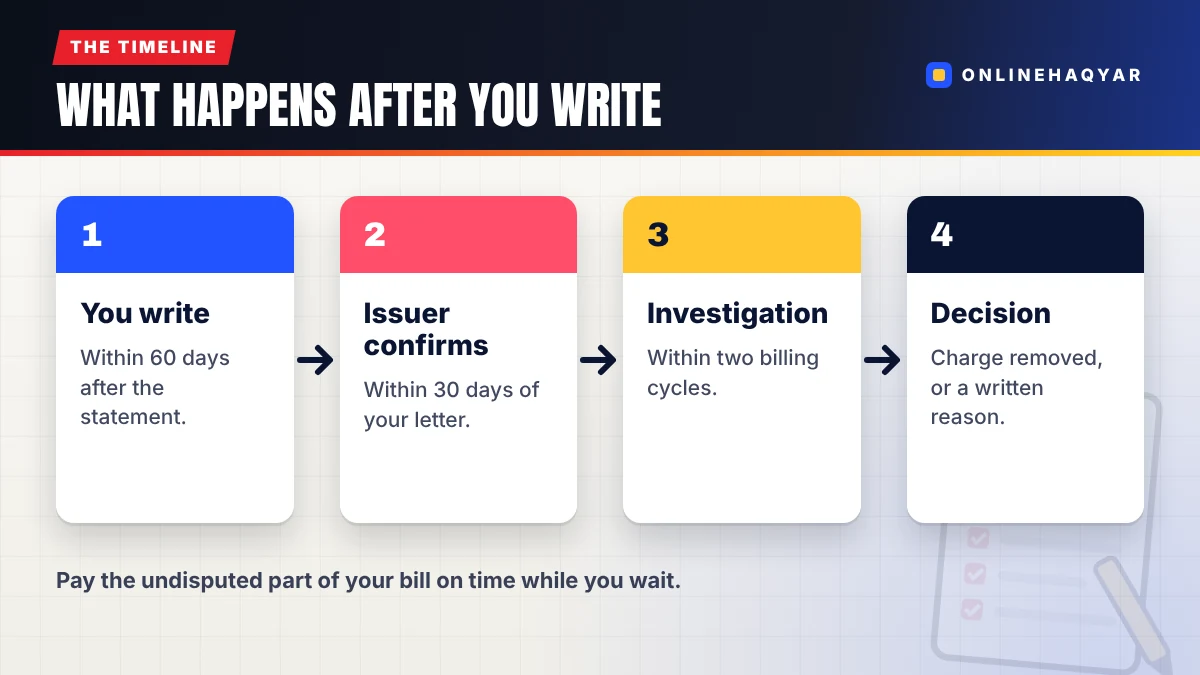
Official guidance (CFPB): After receiving your written notice, the card company must confirm receipt within 30 days and resolve the dispute within two billing cycles after that. If it decides you’re right, it must remove the charge. If not, it must explain why in writing, tell you how much you owe, and give you the due date.
Step 6: Keep records and follow up
Official guidance (CFPB): Keep copies of everything and note the dates of any follow-up calls.
Official guidance (CFPB guide): If you can’t resolve the problem, you can submit a complaint to the CFPB at consumerfinance.gov/complaint or by calling (855) 411-2372. The CFPB says it generally forwards complaints to the company within 15 days.
Unauthorized charges: a different, simpler rule
If a charge isn’t a mistake but fraud, the rules on your liability are separate from the billing-error process.
Official source (FTC): If your credit card account number is used but your card isn’t lost or stolen, you aren’t responsible for any charges you didn’t authorize. If the card itself is lost or stolen and used before you report it, the maximum you might be responsible for is $50. (FTC: Lost or stolen credit, ATM and debit cards)
Author’s analysis: Report fraud to your card company the moment you spot it, then follow up in writing. If your card number was stolen through a fake shop or a scam text, our guides on how to spot a fake online store and the unpaid toll text scam explain what else to do.
Faulty goods or a seller who won’t refund
Can you dispute a credit card charge for a faulty product? Sometimes, but the route is different.
Official guidance (CFPB): Problems with the quality of goods or services may need a different dispute process from billing errors.
Official source (California Attorney General): The California AG’s consumer guide describes this “claims and defenses” route and lists conditions that must all be met: the disputed amount is over $50; the seller is in the same state as you or within 100 miles of your billing address (the guide notes this may not apply to online or phone purchases); you already made a good-faith effort to fix the issue with the seller; and you haven’t fully paid for the item. (California AG: Credit cards, disputing a charge)
Author’s tip: Contact the seller first and keep their reply in writing. Then ask your card company which dispute route applies to your purchase. Your card agreement may describe extra options, so ask.
What about buy now, pay later and debit cards?
Author’s analysis: The billing-error rules above are for credit cards. Debit cards and buy now, pay later loans work differently, and your protections depend on the product and the provider’s terms. If you used “pay in 4” for holiday gifts, read our buy now, pay later risks checklist before assuming you can dispute a charge the same way.
Outside the US?
This guide covers US federal rules only. Canadian and UK cardholders have different protections, so check your card issuer’s dispute policy and your national consumer agency.
Frequently asked questions
How long do I have to dispute a credit card charge?
For a billing error, the CFPB says to send written notice within 60 calendar days after the charge appeared on your statement. Call your issuer as soon as you notice, too.
Do I have to pay the disputed amount while it’s investigated?
No, but you must pay the rest of your bill on time. The card company can’t charge interest on the disputed amount during the investigation.
Will a dispute hurt my credit?
According to the CFPB, the company can’t report your payment as late if you paid the undisputed amount on time.
Can I dispute a credit card charge by phone?
Call right away, but the billing-error process relies on a written notice within 60 days. A call alone may not protect your rights.
What if someone stole my card number?
Report it immediately. The FTC says that if only your account number was used and the card wasn’t lost or stolen, you aren’t responsible for charges you didn’t authorize.
The bottom line
Speed and paper protect you most. Call your issuer as soon as you spot the problem, then back it up with a written notice within 60 days of the statement. Pay the undisputed balance on time, keep copies, and let the deadlines work in your favour. Knowing how to dispute a credit card charge turns a holiday billing mistake into a short to-do list.