
Last updated: November 2026. This article is general consumer information, not legal or financial advice.
Holiday sales bring real bargains, and they also bring copycat shops built to take your money. A fake online store can look polished, use a famous brand’s logo and run ads in your social feed. The good news is that most fake shops fail a few simple checks you can run in five minutes, before you type in a card number.
This guide gives you a seven-point checklist, explains which payment methods give you a way to get your money back, and tells you exactly what to do and where to report if you have already paid.
Why fake shops multiply around Black Friday
Official guidance (US FTC): The Federal Trade Commission warns that scammers often pretend to be real companies on social media and advertise brand-name products at unusually low prices. Clicking the ad can lead to a site that sells counterfeits, sends you something different, or sends nothing at all. (FTC consumer alert)
Author’s analysis: Sale season is perfect cover for a fake online store. Everyone expects big discounts on Black Friday and Cyber Monday, so a 70%-off price doesn’t look as strange as it would in March. Scammers rely on that urgency, and on shoppers clicking ads instead of visiting stores they already know.
The 7-point checklist to spot a fake online store
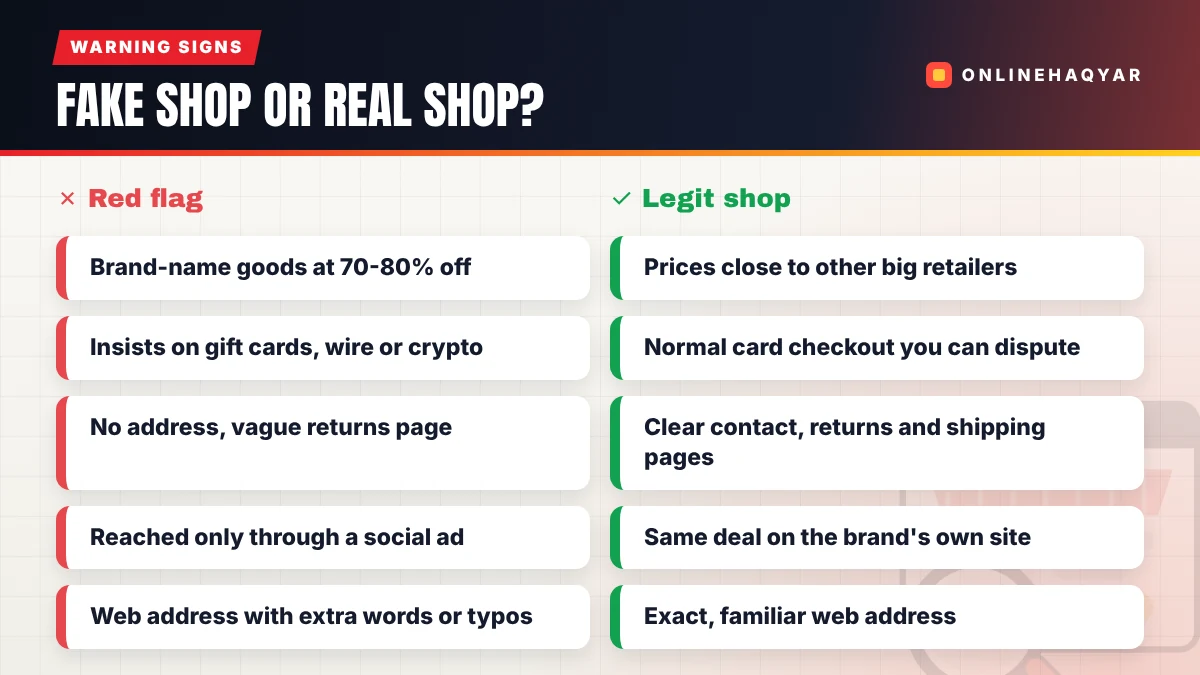
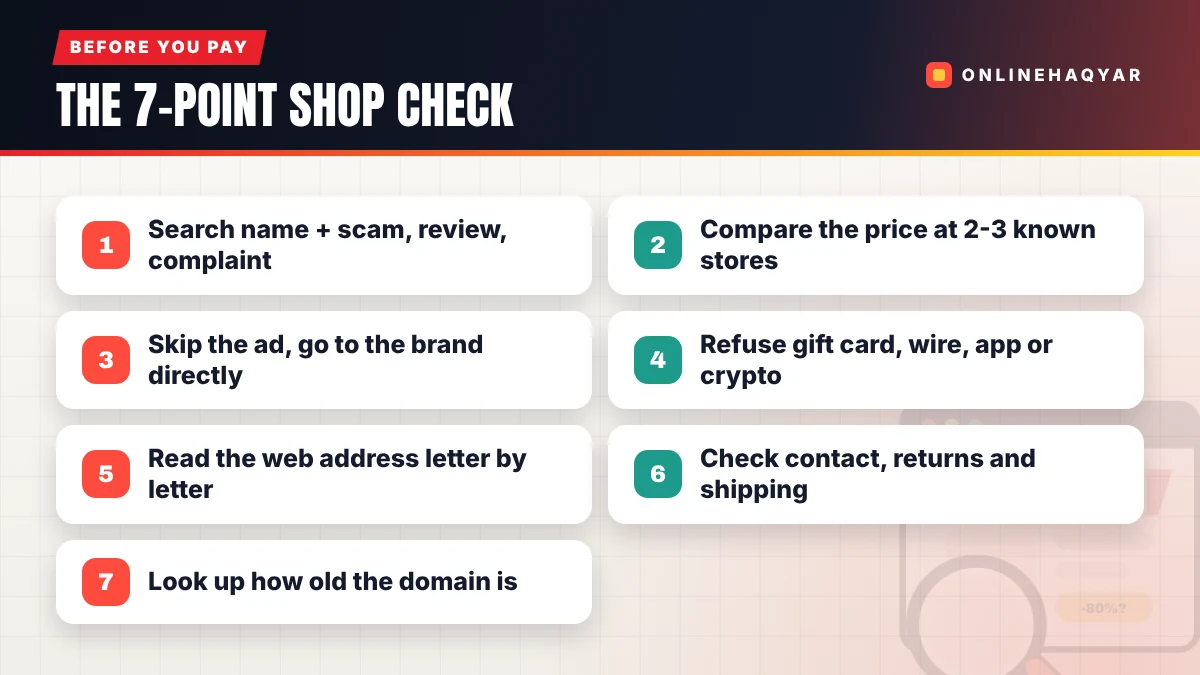
Run through these before you buy from any shop you haven’t used before. One red flag is a reason to slow down. Two or more is a reason to close the tab, because a fake online store rarely fails just one check.
1. Search the shop’s name with “scam”, “review” and “complaint”
Official guidance (FTC): Search the seller’s name and website address together with words like “review”, “complaint” or “scam”.
Search the exact web address too, not just the brand name. Copycat sites often borrow a real brand’s name but sit on a slightly different address.
2. Compare the price with the real market price
Check the same product at two or three retailers you already know. If one unknown site is dramatically cheaper on a popular brand-name item, treat that as a warning, not a lucky find. Our guide to checking whether a Black Friday discount is real shows how to test a “was” price in minutes.
3. Look at how the deal reached you
Official guidance (FTC): Impersonating real companies in social-media ads for cheap brand-name goods is a pattern the FTC specifically flags.
Instead of clicking the ad, type the brand’s official address yourself or open its official app, then look for the same offer there. If the deal only exists inside the ad, it probably doesn’t exist.
4. Check what payment methods the shop insists on
Official guidance (FTC): If a seller insists that you pay with a gift card, wire transfer, payment app or cryptocurrency, the FTC says it’s probably a scam.
A genuine shop may offer many ways to pay, but it won’t insist on methods that are hard to reverse. A request to pay by gift card is a scam on its own; read our explainer on gift card scams for why.
5. Read the web address letter by letter
Look for extra words, swapped letters or unusual endings added to a well-known brand name. Check the address on the checkout page as well as the home page, because some scams redirect you at the last step.
Author’s analysis: The padlock icon in your browser only means the connection is encrypted. It doesn’t prove the business is honest. Scam sites can have a padlock too.
6. Check the contact, returns and shipping pages
Real shops normally publish a business address, a working customer-service contact, and clear returns and shipping policies. Vague, copied or missing policy pages are a red flag. If you’re unsure, email a simple question before ordering. No reply is an answer in itself.
Reviews matter too, but they can be faked in both directions. Our guide on how to spot fake reviews explains the checks that work better than gut feeling.
7. Check how old the website is
A shop that claims it has been “trusted for 15 years” but sits on a domain registered a few weeks ago deserves suspicion. Many a fake online store is set up just weeks before a big sale and abandoned soon after. Public domain-registration records, including the creation date, can be looked up with a free domain lookup tool such as ICANN Lookup. Some owners hide their details, which is normal; the creation date is the useful part.
Pay in a way that lets you dispute the charge
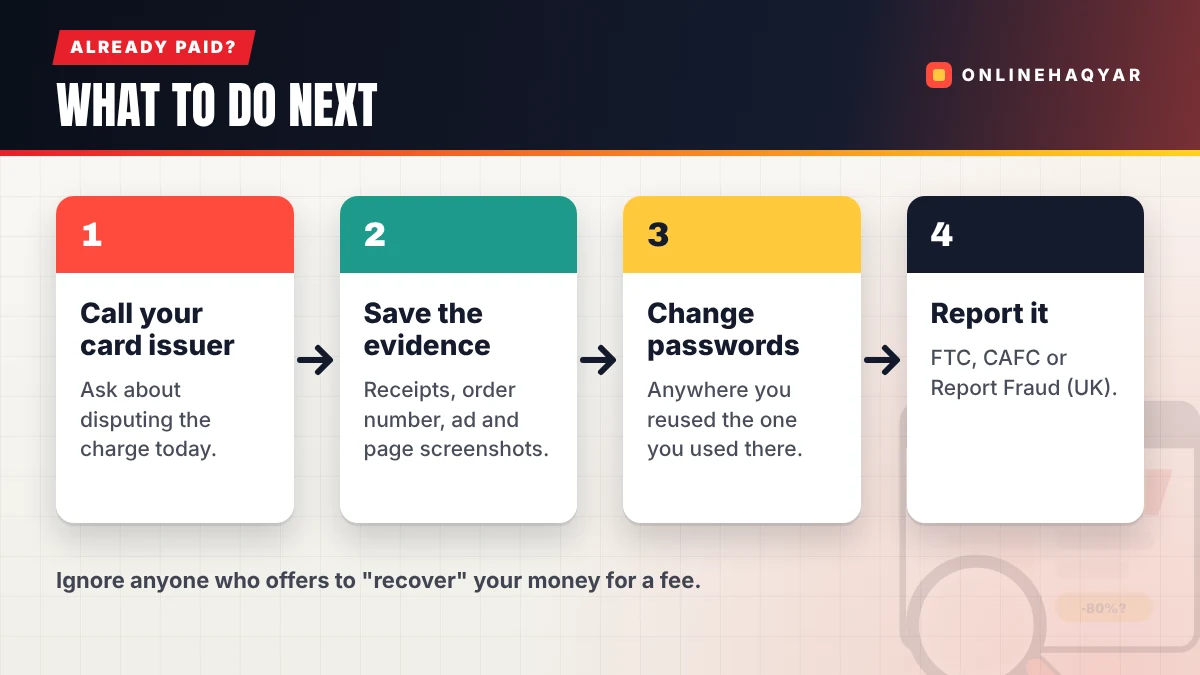
Official guidance (FTC): The FTC recommends paying by credit card where possible, because you can dispute charges for problems such as being billed twice, items that never arrive, or wrong or damaged goods. Keep your receipts and order confirmation numbers.
Author’s analysis: Buy now, pay later plans and payment apps feel just as easy at checkout, but they don’t always give the same protection when a shop turns out to be fake. If you’re weighing a “pay in 4” option, read our buy now, pay later risks checklist first.
Readers in Canada and the UK: card dispute and refund rights differ by country and by card issuer, so check your issuer’s dispute policy before relying on it.
Already paid a fake online store? What to do next
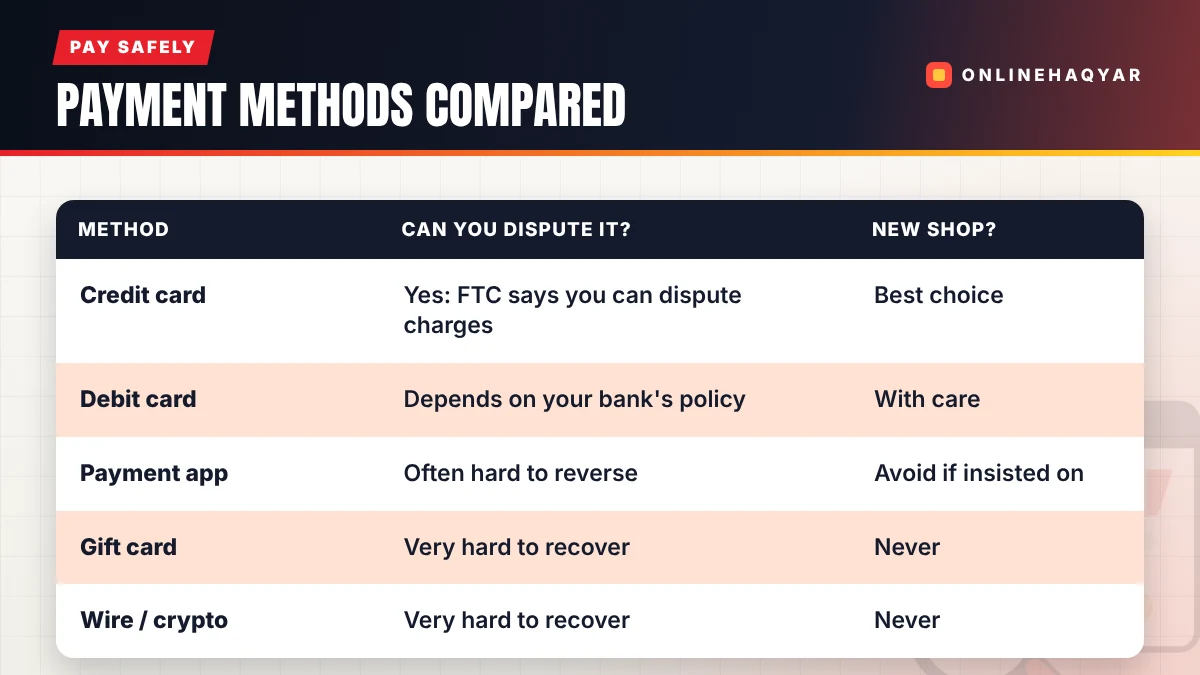
Speed matters. Work through these steps in order:
- Contact your card issuer or bank straight away. Explain that you believe the purchase was a scam and ask about disputing the charge.
- Save your evidence: order confirmation, receipts, screenshots of the ad and product page, and any emails.
- Change your passwords if you created an account on the site with a password you use anywhere else.
- Watch for follow-up scams. People who lose money are sometimes targeted again by “refund recovery” offers. Treat any offer to recover your money for a fee as another scam.
- Report it, using the official channel for your country below.
Fake shops often send “your order has shipped” texts with tracking links. If one arrives, read our guide to the fake delivery text scam before you tap anything.
Where to report a fake online store
| Country | Where to report | Notes |
|---|---|---|
| United States | ReportFraud.ftc.gov | Run by the Federal Trade Commission |
| Canada | Canadian Anti-Fraud Centre | Online, or 1-888-495-8501; contact local police if you lost money |
| England, Wales, Northern Ireland | Report Fraud | Replaced Action Fraud from 4 December 2025; phone 0300 123 2040 |
| Scotland | Police Scotland | Call 101 |
Official sources: The Canadian Anti-Fraud Centre’s reporting page lists online reporting and its toll-free number. GOV.UK confirms that Report Fraud replaced Action Fraud as the national reporting service, and City of London Police says people in Scotland should keep calling Police Scotland on 101.
Quick checklist to save
- Searched the shop name with “scam”, “review” and “complaint”
- Compared the price with two or three known retailers
- Went to the brand’s own site instead of clicking the ad
- Seller doesn’t insist on gift cards, wire transfers, payment apps or crypto
- Checked the web address letter by letter, including at checkout
- Contact, returns and shipping pages look real
- Paying by credit card and saving receipts and order numbers
Frequently asked questions
Is a website safe if it has a padlock (HTTPS)?
No. The padlock means your connection to the site is encrypted, not that the seller is trustworthy. Fake shops can have one too.
What’s the safest way to pay an unfamiliar online store?
The FTC recommends a credit card where possible, because you can dispute charges. Be very wary if a seller insists on gift cards, wire transfers, payment apps or cryptocurrency.
I found the deal in a social-media ad. Is it real?
It might be, but the FTC warns that scammers impersonate real brands in social ads. Go to the brand’s official website directly and look for the same offer.
My order never arrived. What should I do?
Contact the seller, then your card issuer to ask about a dispute. Keep every receipt and confirmation number, and report the shop through your country’s official channel.
The bottom line
You don’t need special tools to avoid a fake online store. Search the name, sanity-check the price, go to the brand directly instead of the ad, and pay in a way you can dispute. If something feels off, close the tab. A missed “deal” costs you nothing.