
Last updated: November 2026. This article is general consumer information, not legal advice.
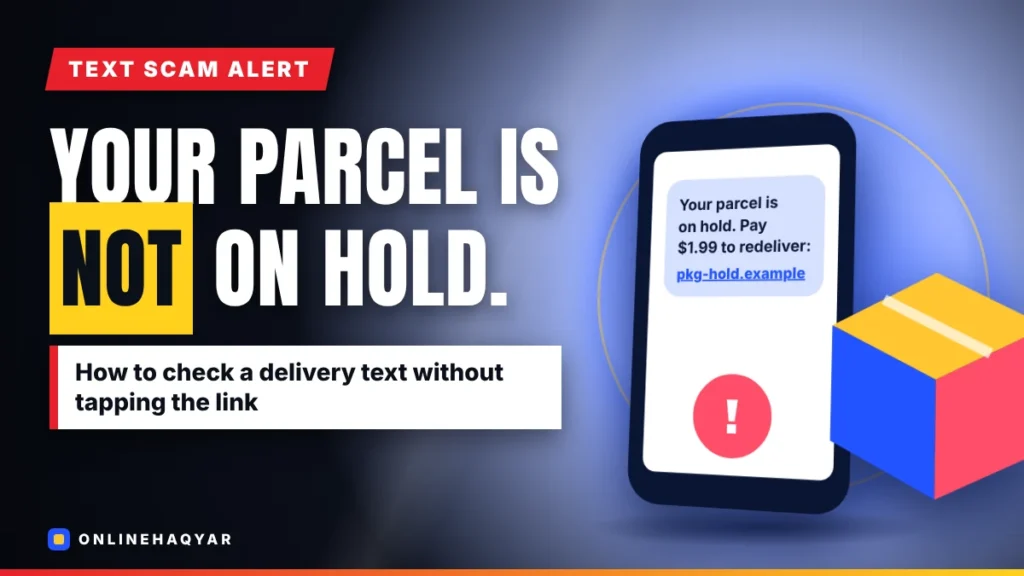
During holiday shopping you may be waiting on several parcels at once, which makes a “missed delivery” message easy to believe. That’s exactly why the fake delivery text is one of the most common scams of the season. This guide explains what these messages look like, how to check your parcel without tapping the link, and what to do if you already did.
Why fake delivery texts work so well
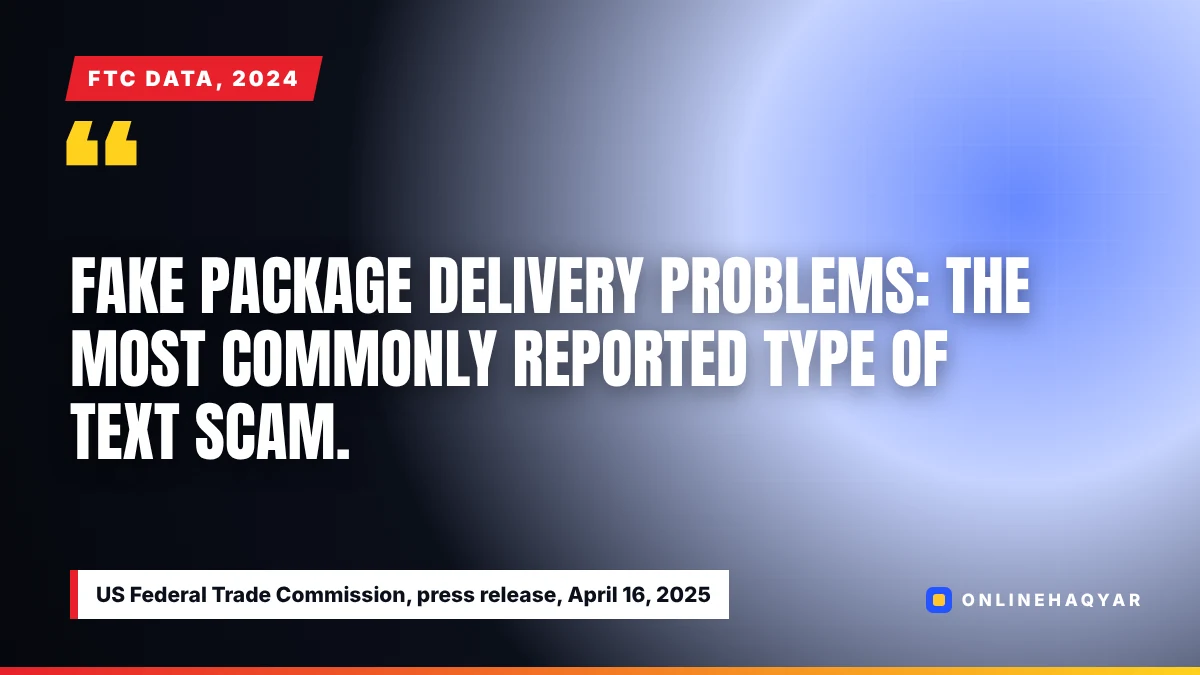
Official source (US FTC): In data released on April 16, 2025, the FTC said consumers reported losing $470 million in 2024 to scams that started with text messages. It described texts about “a supposed issue with an incoming delivery” as “the most commonly reported type of text scam.” (FTC press release)
Author’s analysis: The timing does most of the work. Between Black Friday and the holidays, many of us genuinely are waiting on parcels from several retailers and carriers. A short message about a “delivery problem” fits right into that, and a tiny “redelivery fee” doesn’t feel worth questioning.
What a fake delivery text looks like
Official guidance (FTC): The FTC’s holiday shipping alert describes messages saying a delivery was missed or that you need to update your shipping preferences, usually with a link. The link may lead to a look-alike website that captures what you type, or it may install malware. Scammers are after usernames and passwords for your bank, email or social accounts. (FTC shipping-notification alert)
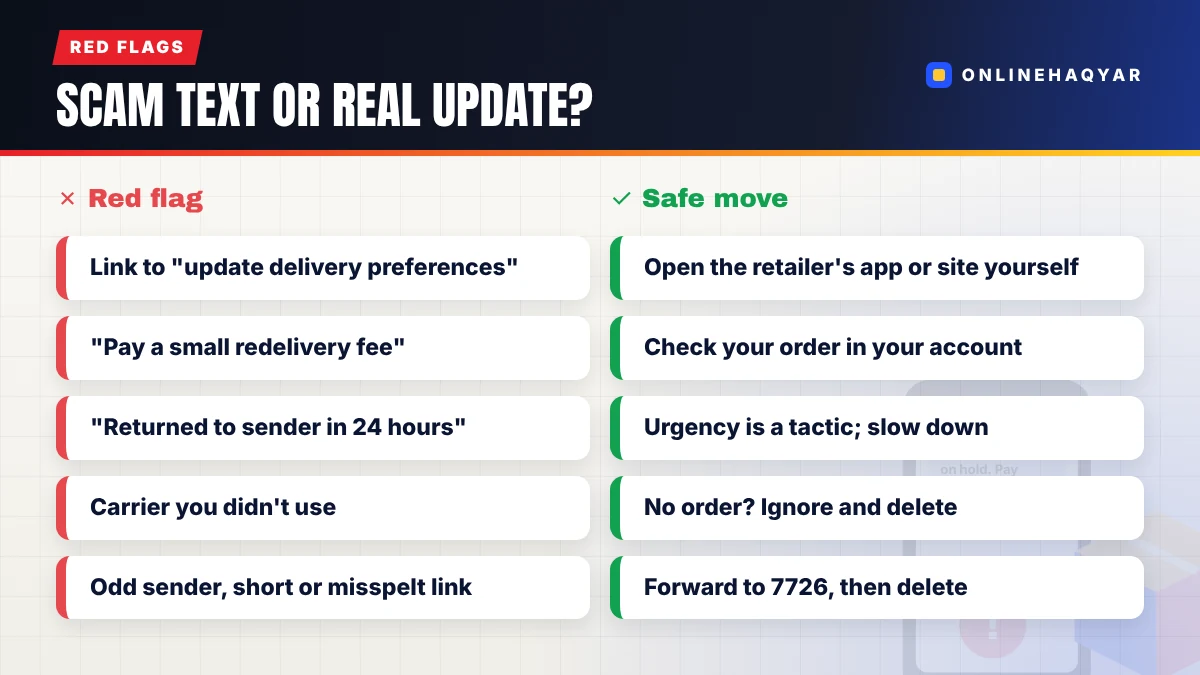
Common red flags:
- A link to “confirm your address” or “update delivery preferences”.
- Urgency, such as a warning that your parcel will be returned unless you act within hours.
- A small fee for “redelivery”, “customs” or “address correction”, paid by card.
- A carrier you didn’t use, or a parcel you don’t remember ordering.
- An unusual sender or a shortened, misspelt web address.
Author’s analysis: None of these alone proves a scam, and real carriers do send texts. What matters is that you never need the link in the message to check a real delivery.
How to check your parcel without tapping the link
Official guidance (FTC): “Never click on links or respond to unexpected texts.” If a message might be legitimate, contact the company “using a phone number or website you know is real.”
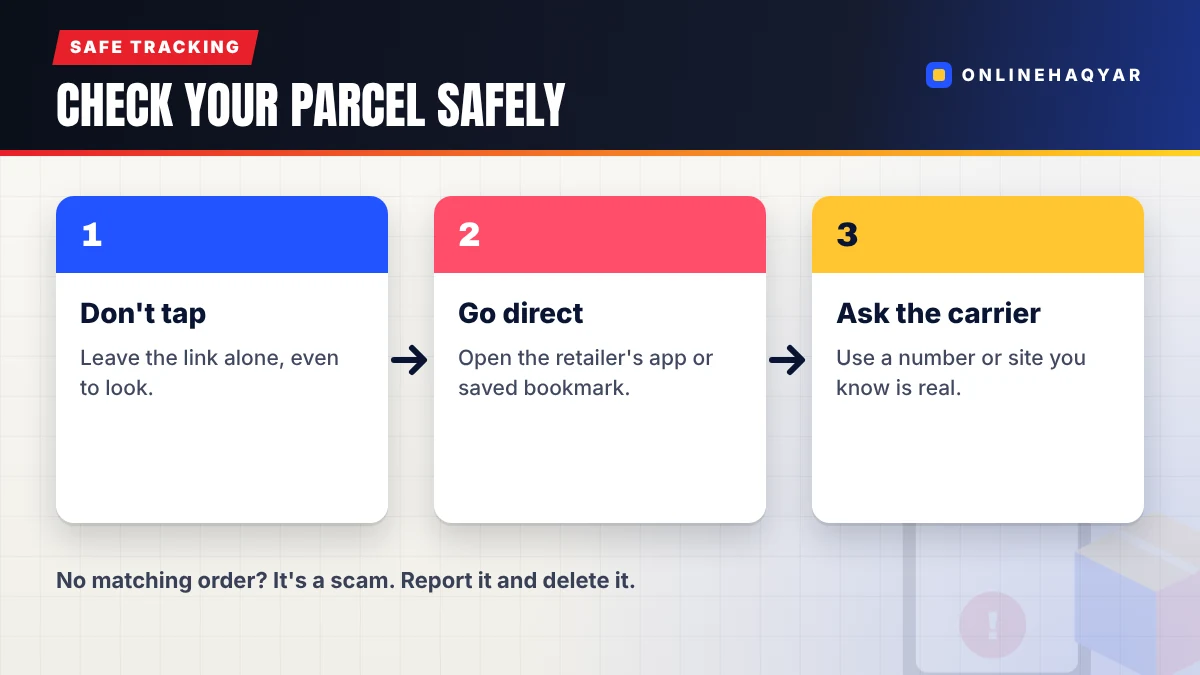
Here’s a simple routine that follows that advice:
- Don’t tap the link, even “just to look”. Some pages start collecting information or downloading files as soon as they open.
- Go direct. Open the retailer’s app, or type its web address yourself, and check the order status in your account.
- Contact the carrier through a channel you already trust, such as its official app or the tracking number in your original order confirmation email.
- No matching order? It’s a scam. Report it and delete it.
Author’s tip: Keep order confirmation emails in one folder during the holidays. Then the question “do I really have a parcel coming from this carrier?” takes ten seconds to answer.
How to report a fake delivery text
Official guidance (FTC): In the US, forward the message to 7726 (SPAM), which the FTC says “helps your wireless provider spot and block similar messages.” You can also use the “report junk” option in your messaging app and report the scam at ReportFraud.ftc.gov.
| Country | How to report | Notes |
|---|---|---|
| United States | Forward to 7726, then ReportFraud.ftc.gov | FTC guidance, April 2025 |
| Canada | Canadian Anti-Fraud Centre | Online or 1-888-495-8501; police if you lost money |
| England, Wales, Northern Ireland | Report Fraud if you lost money | Replaced Action Fraud in December 2025; 0300 123 2040 |
| Scotland | Police Scotland | Call 101 |
Author’s note: UK mobile networks also accept scam texts forwarded to 7726. Check with your provider if you’re unsure.
Already clicked? What to do next
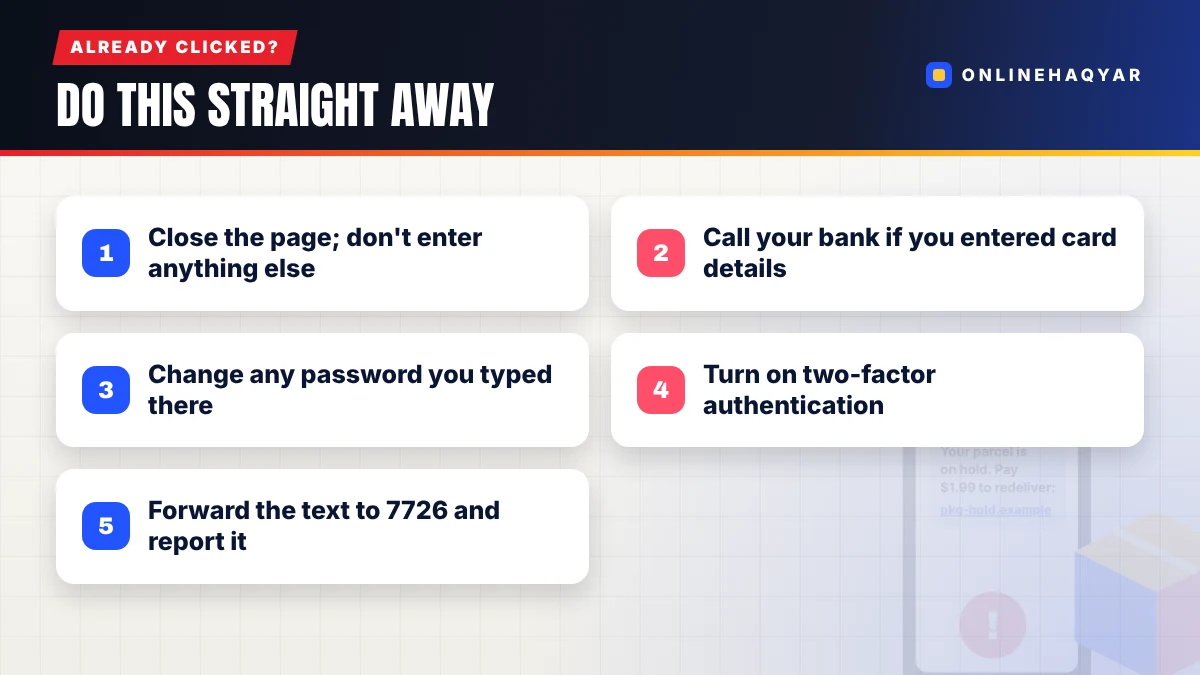
If you tapped the link or typed in details, act quickly:
- Close the page and don’t enter anything else.
- Call your bank or card issuer straight away if you entered card details, using the number on the back of your card.
- Change any password you typed on the page, and anywhere else you reused it.
- Turn on two-factor authentication for your email and bank accounts if it isn’t already on.
- Report the text using the channels above.
Author’s analysis: Watch your inbox and phone over the next few weeks. People who fall for one scam are often targeted again, sometimes with offers to “recover” their money.
Related holiday scams to watch for
Fake delivery texts often follow a purchase from a fake shop, so use our guide on how to spot a fake online store before you buy from an unfamiliar site. If a “delivery company” ever asks you to pay a fee with gift cards, that’s a scam every time; see our explainer on gift card scams.
Frequently asked questions
What if I really am expecting a package?
Check the order on the retailer’s site or app, or contact the carrier through a website or number you already know. Don’t use the link in the text.
Is it safe to reply “STOP” to a scam text?
Author’s analysis: It’s safer not to reply at all. The FTC advises against responding to unexpected texts. Forward it to 7726 and delete it.
Do real carriers charge redelivery fees by text?
Author’s analysis: Treat any unexpected fee request in a text as suspicious. If you think a fee might be genuine, check it in your account on the carrier’s or retailer’s official site.
How did scammers get my phone number?
Author’s analysis: Many of these texts are sent to huge lists of numbers at random. Receiving one doesn’t mean your details were stolen from a specific shop.
The bottom line
A fake delivery text relies on timing and a tiny bit of urgency. Slow down, skip the link, and check your parcel through the retailer or carrier directly. If you did tap, call your bank, change your passwords and report it, and you’ll have done everything that matters.