
Last updated: November 2026. General information for US savers, not financial or tax advice. Figures are from IRS News Release IR-2026-136 and IRS Notice 2026-66 (November 12, 2026). No affiliate links.
The IRS has published next year’s retirement-account limits, and the 2027 contribution limits bring a modest raise for workplace plans. You can put $1,000 more into a 401(k) in 2027, while the IRA limit stays where it is.
This guide puts the 2027 contribution limits in one place, explains the catch-up rules for people aged 50 and over, and finishes with a short checklist to work through before your first paycheck of the new year.
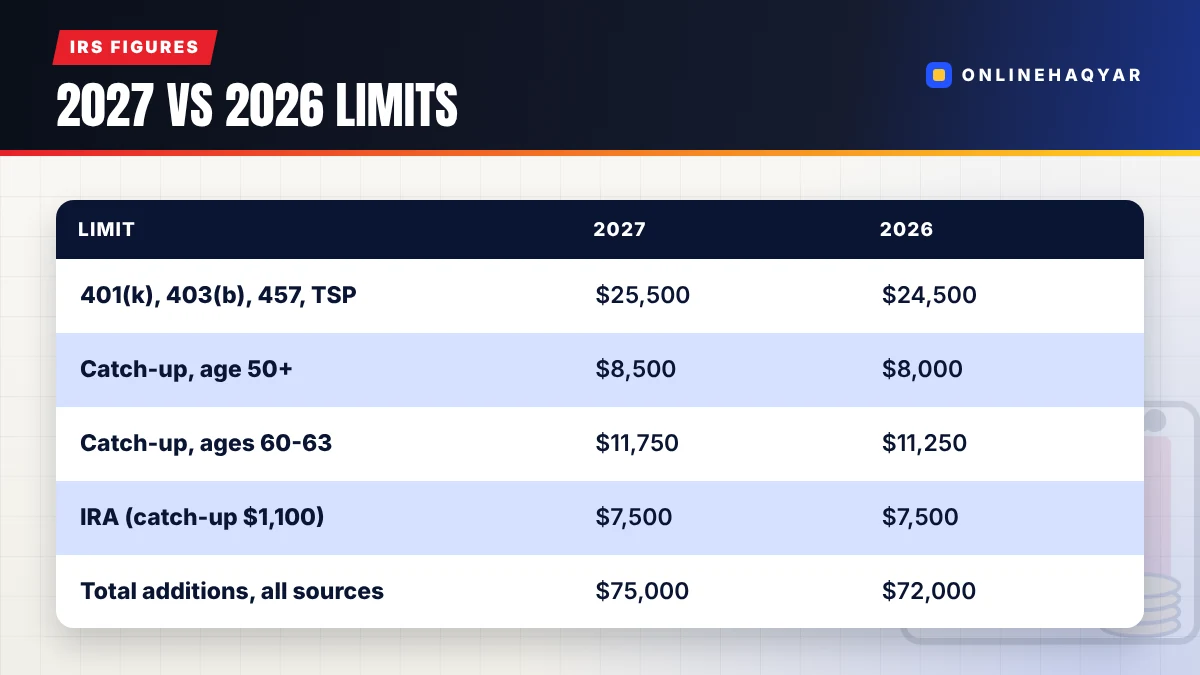
The 2027 contribution limits at a glance
Official source (IRS News Release IR-2026-136 and Notice 2026-66):
| Limit | 2027 | 2026 |
|---|---|---|
| Employee contributions: 401(k), 403(b), governmental 457, Thrift Savings Plan | $25,500 | $24,500 |
| Catch-up, age 50+ (most of the plans above) | $8,500 | $8,000 |
| Higher catch-up, ages 60-63 | $11,750 | $11,250 |
| IRA contribution limit | $7,500 | $7,500 |
| IRA catch-up, age 50+ | $1,100 | $1,100 |
| SIMPLE IRA / SIMPLE 401(k) employee limit | $17,500 | $17,000 |
| Total annual additions to a defined contribution plan (employee + employer) | $75,000 | $72,000 |
You can read the figures yourself in the IRS news release and the full Notice 2026-66 (PDF).
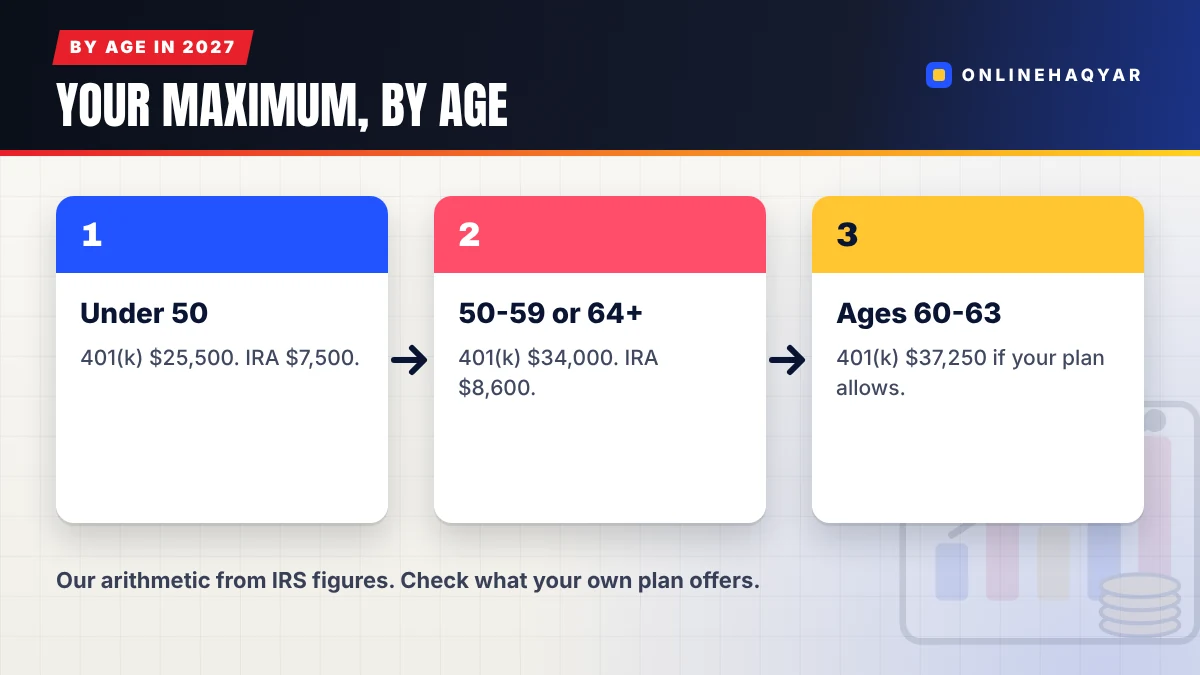
Official source (IRS): A worker aged 50 or over can contribute “up to $34,000” to a 401(k)-type plan in 2027 ($25,500 plus the $8,500 catch-up).
Author’s analysis: For someone aged 60 to 63, the arithmetic is $25,500 + $11,750 = $37,250. The IRS release doesn’t print this total, and not every plan offers every catch-up option, so check your plan’s own materials.
What the higher 401(k) limit means in practice
Author’s analysis (worked example, not a recommendation): If you want to reach the full $25,500 in 2027 and are paid 26 times a year, that’s about $981 per paycheck ($25,500 ÷ 26). Paid monthly, it’s $2,125 a month.
Most payroll systems ask for a percentage rather than a dollar amount. Divide your per-paycheck target by your gross pay per paycheck to find the percentage. For example, $981 on a $4,000 gross paycheck is roughly 24.5%.
Author’s tip: If your current election is a fixed dollar amount set to hit the 2026 limit, it won’t adjust by itself. If it’s a percentage and you get a raise, you may now overshoot or undershoot. Either way, check it in December.
Employer contributions don’t count toward $25,500
Official source (IRS Notice 2026-66): The $25,500 figure is the limit on your own elective deferrals. The separate cap on total additions from all sources, including employer contributions, is $75,000 for 2027.
Catch-up contributions if you’re 50 or older
Under the 2027 contribution limits, catch-ups for workplace plans come in two sizes, and IRAs have their own.
- Ages 50 to 59, or 64 and over: up to $8,500 on top of the $25,500 limit.
- Ages 60 to 63: a higher catch-up of up to $11,750, where your plan offers it.
- IRAs: the catch-up stays at $1,100, so the IRA maximum for people aged 50+ is $8,600 (our arithmetic: $7,500 + $1,100).
The Roth catch-up rule for higher earners
Official source (IRS Notice 2026-66): The notice says the Roth catch-up wage threshold, which “is used to determine whether” an individual’s catch-up contributions for 2027 must be designated as Roth contributions, “is increased from $150,000 to $155,000.”
Author’s analysis: This rule sits alongside the 2027 contribution limits rather than changing them. In plain terms, if your wages from the employer sponsoring your plan were above that threshold, your 2027 catch-up contributions may have to go in as Roth (after-tax) money rather than pre-tax. The notice labels the threshold “for 2026” while applying it to 2027 catch-ups, so exactly which year’s wages count is set by the rule itself. Ask your plan administrator or HR how it applies to you before you change anything.
IRA limits and the 2027 income ranges
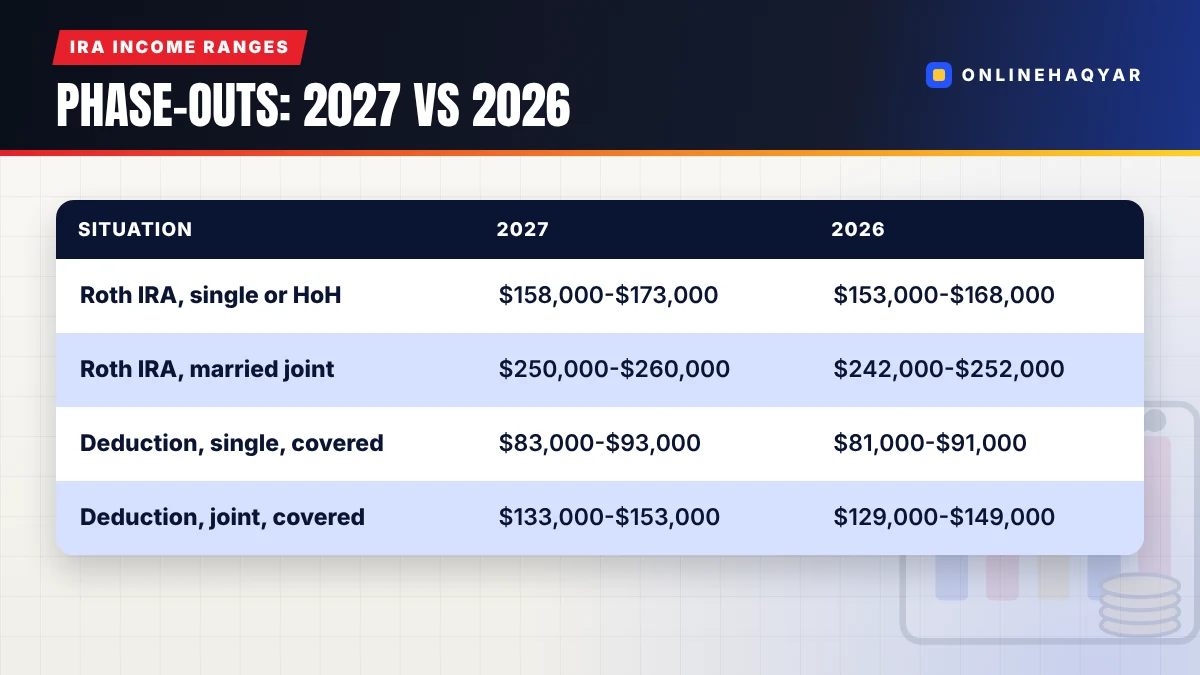
The IRA contribution limit stays at $7,500 (plus the $1,100 catch-up if you’re 50 or over). What did change are the income ranges that decide whether you can deduct a traditional IRA contribution, and whether you can contribute to a Roth IRA at all.
Traditional IRA deduction phase-outs
Official source (IRS): These ranges apply only if you, or your spouse, are covered by a workplace retirement plan.
| Your situation | 2027 phase-out (modified AGI) | 2026 |
|---|---|---|
| Single or head of household, covered by a workplace plan | $83,000 – $93,000 | $81,000 – $91,000 |
| Married filing jointly, contributing spouse covered | $133,000 – $153,000 | $129,000 – $149,000 |
| Not covered, but married to someone who is | $250,000 – $260,000 | $242,000 – $252,000 |
| Married filing separately, covered | $0 – $10,000 | $0 – $10,000 |
Roth IRA contribution phase-outs
Official source (IRS):
| Filing status | 2027 phase-out (modified AGI) | 2026 |
|---|---|---|
| Single or head of household | $158,000 – $173,000 | $153,000 – $168,000 |
| Married filing jointly | $250,000 – $260,000 | $242,000 – $252,000 |
| Married filing separately | $0 – $10,000 | $0 – $10,000 |
Author’s analysis: Inside a range you can make a reduced contribution; above it, none. If your income is close to the top of a range, estimate your 2027 modified AGI before you contribute rather than afterwards. Fixing an excess contribution later is more work than getting it right first time.
The Saver’s Credit is changing
Official source (IRS Notice 2026-66, footnote 2): Effective for taxable years beginning after December 31, 2026, “Saver’s Match contributions under section 6433 will replace the Saver’s Credit under section 25B” for elective contributions to qualifying retirement plans and IRAs.
Author’s analysis: If you’ve claimed the Saver’s Credit for 401(k) or IRA contributions in the past, don’t assume the same credit applies in 2027. This article doesn’t explain how the new Saver’s Match works, because the IRS documents we read don’t describe it in detail. Look for IRS guidance on the Saver’s Match before you plan around it.
Self-employed or freelancing?
The 2027 contribution limits above are for employees and IRA owners. If you work for yourself, your options depend on the type of plan you use, and good income records matter more than ever. Our freelance invoice guide covers the paperwork side, and if you sell online or get paid through apps, read our explainer on the Form 1099-K $20,000 / 200 rule.
Author’s tip: Retirees and people close to retirement have other 2027 numbers to check too. See our guides to the Social Security COLA for 2027 and the Medicare Part B premium for 2027, because large IRA withdrawals can affect Medicare costs for higher earners.
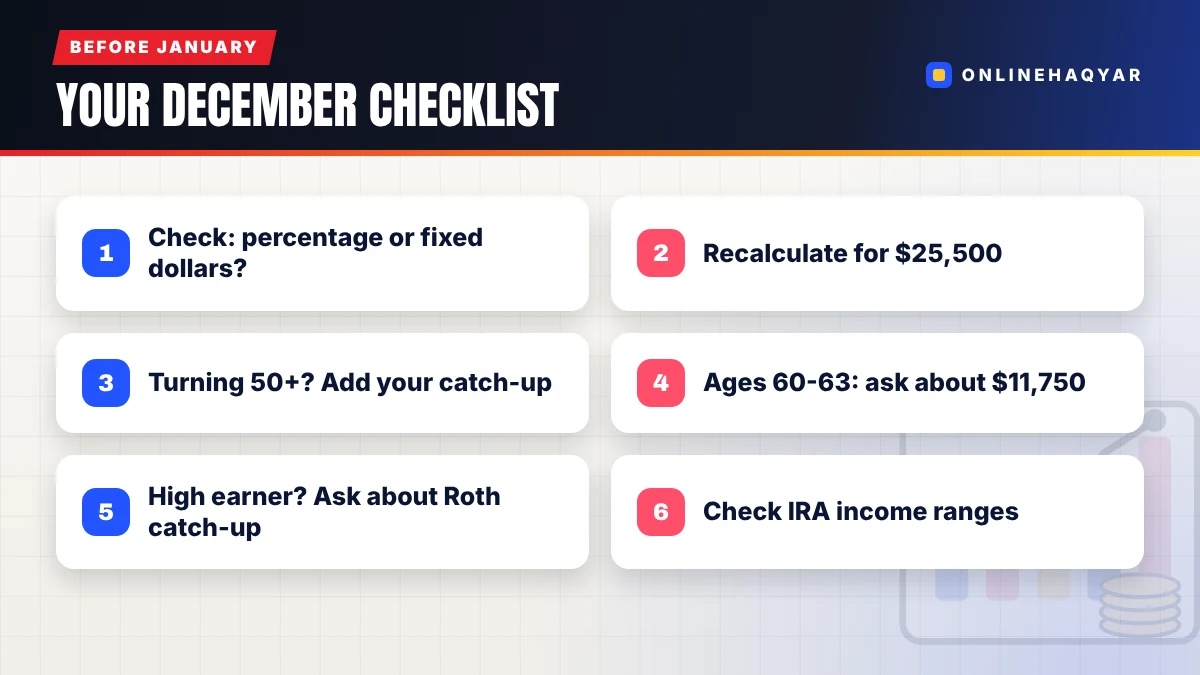
Your before-January checklist
Author’s opinion:
- Log in to your 401(k) or payroll portal and check whether your contribution is a percentage or a fixed dollar amount.
- Recalculate if you aim to max out: $25,500 for 2027, plus catch-up if you’ll be 50 or older by the end of the year.
- Turning 60, 61, 62 or 63 in 2027? Ask whether your plan offers the higher $11,750 catch-up.
- Higher earner? Ask HR whether your catch-ups must be Roth contributions in 2027.
- Check your IRA eligibility against the 2027 income ranges above, not just the 2027 contribution limits.
- Write down the date you made each change, and check your first January pay stub.
Frequently asked questions
What is the 401(k) limit for 2027?
$25,500 for employee contributions, up from $24,500 in 2026, according to the IRS.
What is the 401(k) catch-up limit for 2027?
$8,500 if you’re 50 or older, or up to $11,750 if you’re aged 60 to 63 and your plan offers the higher catch-up.
Did the IRA limit change for 2027?
No. It stays at $7,500, with a $1,100 catch-up for people aged 50 and over.
What is the Roth IRA income limit for 2027?
The phase-out range is $158,000 to $173,000 for single filers and $250,000 to $260,000 for married couples filing jointly.
Do employer contributions count toward the $25,500?
No. $25,500 is the employee limit. Total contributions from all sources are capped at $75,000 for 2027.
The bottom line
The 2027 contribution limits bring a $1,000 bump for workplace plans ($25,500, or $34,000 if you’re 50 or older) and no change to the IRA limit ($7,500). The real risks aren’t the numbers themselves; they’re stale payroll elections, missed catch-ups and surprises near the income limits. Spend ten minutes in December updating your elections and you’ll start 2027 on track.