

Last updated: November 2026. General information for Canadian workers, not financial, tax or payroll advice. Figures are from Canada Revenue Agency (CRA) pages modified 2026-11-09 and read 22 November 2026. No affiliate links.
Starting January 1, 2027, the CPP contribution rate for employees and employers drops from 5.95% to 5.75% each. At the same time, the earnings ceiling goes up, so the saving isn’t the same for everyone.
Here’s what the new CRA figures say, why the CPP contribution rate is falling, and what the change means in dollars for employees, employers and the self-employed.
The 2027 CPP numbers at a glance
Official source (CRA, “CPP contribution rates, maximums and exemptions”, modified 2026-11-09): CRA’s CPP rates page lists these figures, marking 2027 as “New”:
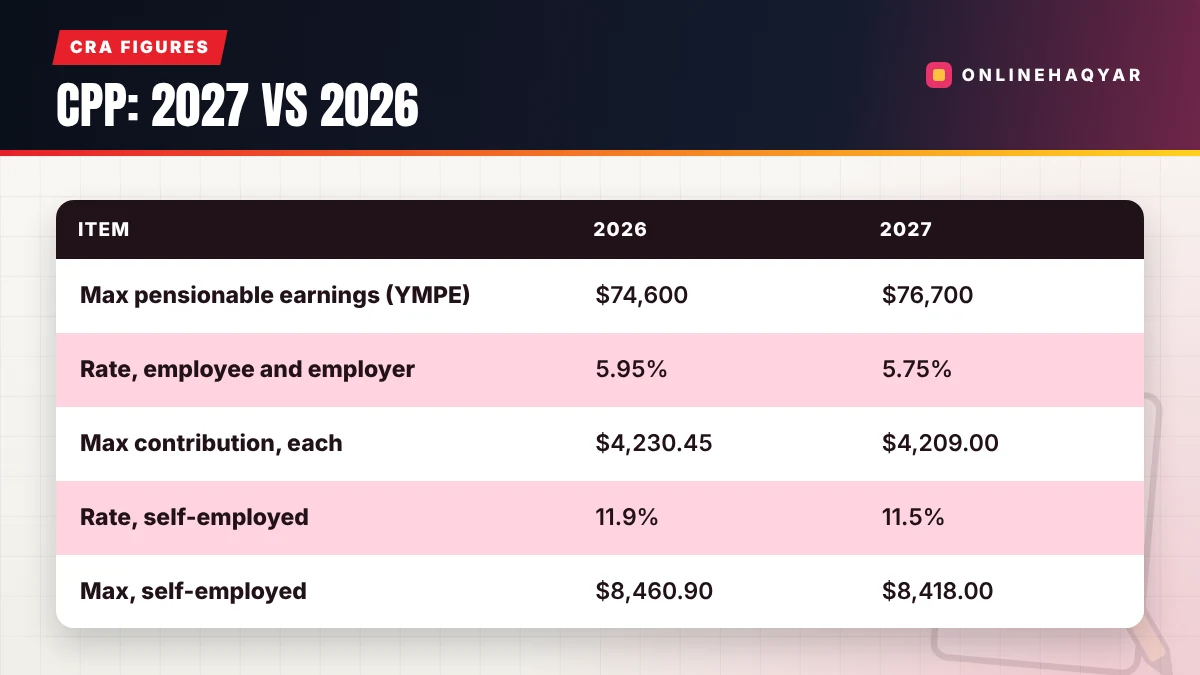
| Item | 2026 | 2027 |
|---|---|---|
| Maximum annual pensionable earnings (YMPE) | $74,600 | $76,700 |
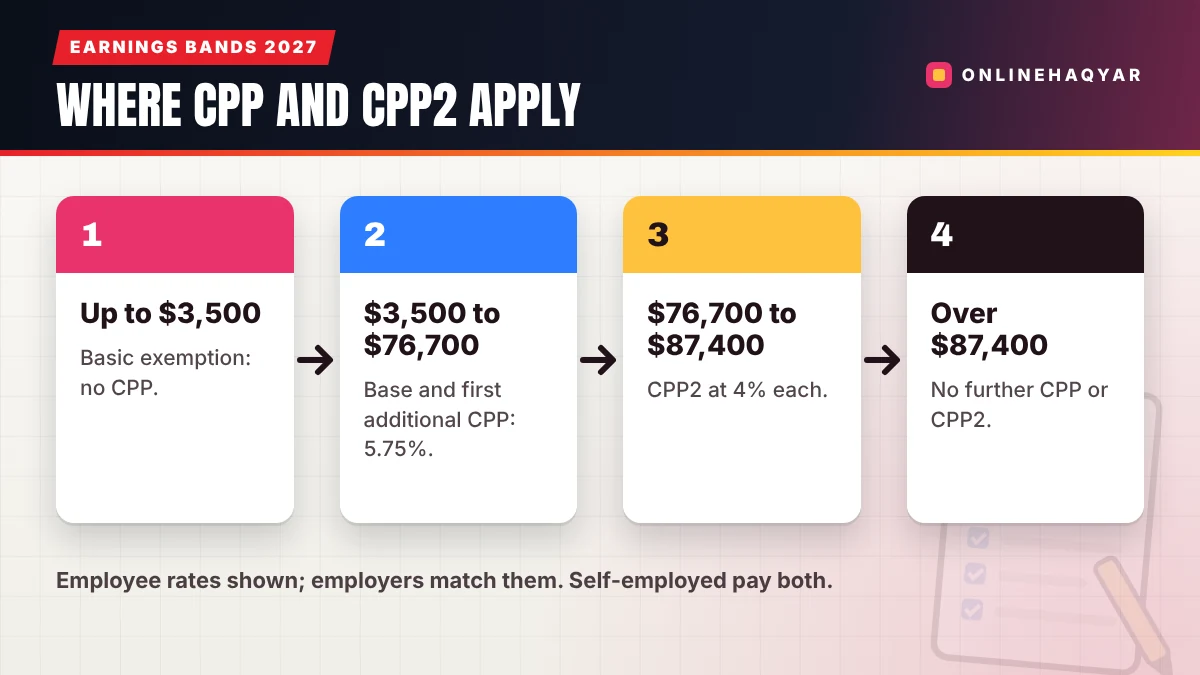
| Basic exemption | $3,500 | $3,500 |
| Maximum contributory earnings | $71,100 | $73,200 |
| CPP contribution rate, employee and employer (each) | 5.95% | 5.75% |
| Maximum CPP contribution, employee and employer (each) | $4,230.45 | $4,209.00 |
| Maximum CPP contribution, self-employed | $8,460.90 | $8,418.00 |
Official source (CRA, “Second additional CPP (CPP2) contribution rates and maximums”, modified 2026-11-09): The CPP2 page gives:
| Item | 2026 | 2027 |
|---|---|---|
| Additional maximum pensionable earnings (YAMPE) | $85,000 | $87,400 |
| CPP2 rate, employee and employer (each) | 4% | 4% |
| Maximum CPP2 contribution, employee and employer (each) | $416 | $428 |
| Maximum CPP2 contribution, self-employed | $832 | $856 |
Author’s analysis (arithmetic check): ($76,700 − $3,500) × 5.75% = $4,209.00, and ($87,400 − $76,700) × 4% = $428. The self-employed rates of 11.5% (2027) and 11.9% (2026) are double the employee rate, because self-employed people pay both shares.
Why the CPP contribution rate is falling
Official source (CRA, Payroll Deductions Formulas T4127, 124th edition, effective January 1, 2027): CRA’s T4127 payroll formulas say the Government of Canada announced on April 28, 2026 “the reduction of the base CPP contribution rate from 9.90% to 9.50%, effective January 1, 2027.” For employees and employers, “the base contribution rate will decrease from 4.95% to 4.75%.” CRA adds: “The first additional contribution rate and second additional contribution rate will not be impacted.”
Author’s analysis: So only the base part of CPP falls. The 1% “first additional” part from the CPP enhancement stays, which is how the total employee rate becomes 4.75% + 1% = 5.75%.
Source (Advisor.ca, November 13, 2026): Advisor.ca reports that the change follows a report from the Office of the Chief Actuary, which found a base CPP rate of 4.75% from 2027 to be sufficient.
What you’ll actually save, and why some people save very little
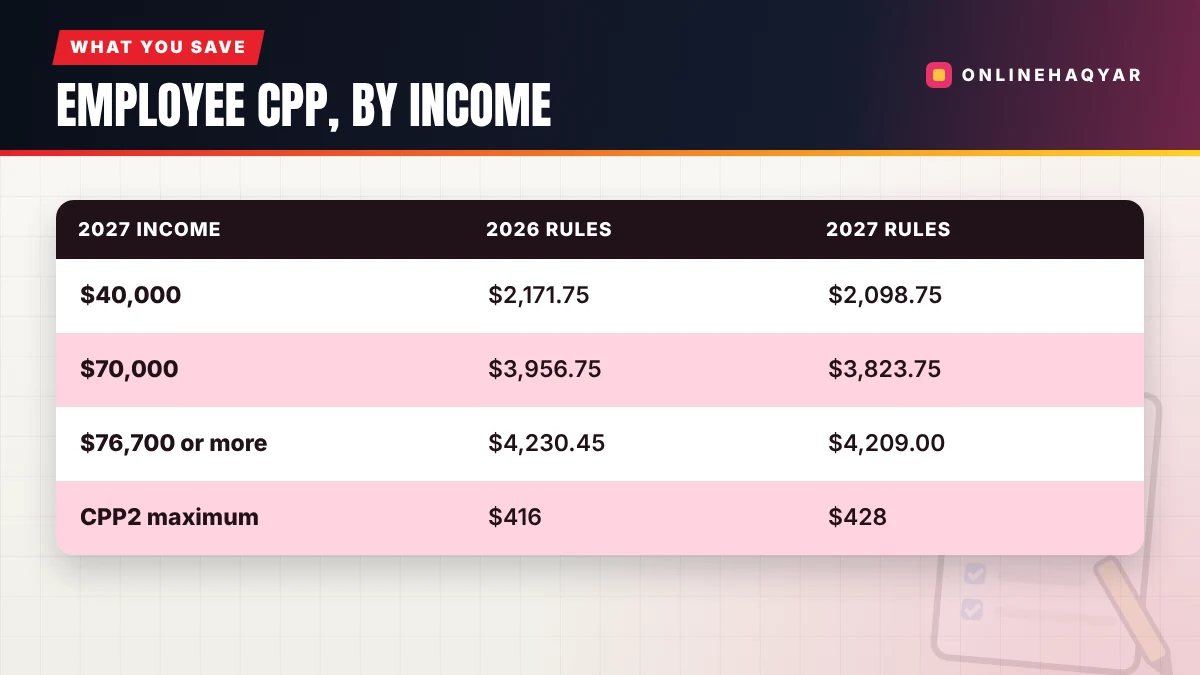
Author’s analysis (employee base CPP only; your employer pays the same): The “2026 rules” column applies the 2026 rate and ceiling to the same income, so you can see the effect of the change on its own.
| Your 2027 employment income | 2026 rules | 2027 rules | Difference |
|---|---|---|---|
| $40,000 | $2,171.75 | $2,098.75 | $73.00 less |
| $70,000 | $3,956.75 | $3,823.75 | $133.00 less |
| $76,700 or more | $4,230.45 (2026 max) | $4,209.00 (2027 max) | $21.45 less |
For a $40,000 earner, ($40,000 − $3,500) × 5.95% = $2,171.75 at the old CPP contribution rate, compared with × 5.75% = $2,098.75 at the new one.
Source (Money.ca): Money.ca reports a Finance Canada estimate that an employee earning $70,000 saves about $133 a year, which matches our arithmetic.
Author’s analysis: High earners save less because the ceiling rises at the same time as the rate falls. If you earn $87,400 or more, your CPP2 contribution also rises by $12, from $416 to $428. Your total CPP plus CPP2 saving at the very top is therefore about $9.45 ($4,646.45 in 2026 vs $4,637.00 in 2027).
Author’s opinion: For most people, this CPP contribution rate cut is a small, welcome change of a few dollars per pay period. Don’t rebuild your budget around it, but do check that your January payslip uses the new rate.
CPP2: the second ceiling
Author’s analysis: CPP2 applies only to earnings between the YMPE ($76,700) and the YAMPE ($87,400) in 2027. If you earn $76,700 or less, you pay no CPP2. The CPP2 rate stays at 4% each for employee and employer, so the 2027 maximum is $428 each.
Self-employed: you pay both sides
Official source (CRA): For 2027, the maximum self-employed CPP contribution is $8,418.00, and the maximum self-employed CPP2 contribution is $856.
Author’s analysis: At the maximum, a self-employed person’s 2027 total is $8,418 + $856 = $9,274. For 2026 it was $8,460.90 + $832 = $9,292.90, so the saving at the top is $18.90. If you pay tax by instalments, talk to your accountant about whether your 2027 amounts need adjusting. Our freelance invoice guide can help you keep the income records that make this easier.
Does a lower CPP contribution rate mean a smaller pension?
Author’s analysis: The CRA pages we read cover contributions only, not benefits, so this article doesn’t say how the rate change affects any future pension. For how CPP retirement pension amounts are worked out, see the Government of Canada’s page on how much you could receive, or ask Service Canada about your own record.
Your January checklist
Author’s opinion:
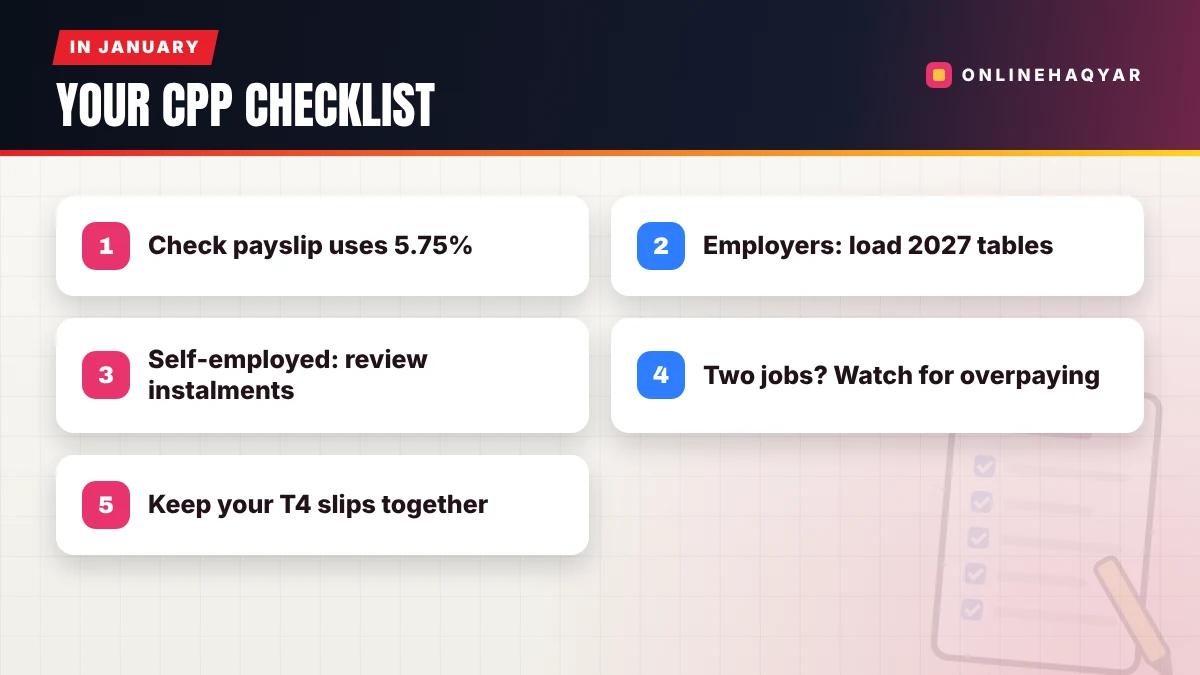
- Employees: compare your first 2027 payslip with your last 2026 one. The CPP deduction should reflect 5.75%.
- Employers: update payroll software to the 2027 tables, or confirm that your provider has done so.
- Self-employed: review your instalments if you base them on estimated 2027 income.
- More than one job? Each employer deducts CPP separately, so your combined deductions can exceed the yearly maximum. Check how any excess is handled when you file your return, or ask CRA.
- Keep your T4 slips together so you can check total CPP and CPP2 at tax time.
RRSP season starts soon too: our guide to the RRSP limit for 2027 explains the $35,390 dollar limit and the March 1, 2027 deadline. Cross-border readers can compare the US Social Security COLA for 2027.
Frequently asked questions
What is the CPP contribution rate for 2027?
5.75% each for employees and employers, and 11.5% for the self-employed, according to CRA.
What is the maximum CPP contribution for 2027?
$4,209.00 for employees, and the same for employers. The self-employed maximum is $8,418.00.
What is the YMPE for 2027?
$76,700, up from $74,600 in 2026.
What is the CPP2 maximum for 2027?
$428 for employees (and the same for employers), and $856 for the self-employed.
Which part of the rate was cut?
The base part of the CPP contribution rate, from 4.95% to 4.75% each. CRA says the first and second additional rates are not affected.
The bottom line
In 2027, the CPP contribution rate falls to 5.75% for employees and employers (11.5% for the self-employed), while the earnings ceiling rises to $76,700. Middle-income workers save the most, about $133 a year at $70,000. People at the maximum save only a few dollars, because the higher ceiling and CPP2 offset most of the cut. Check your first payslip of 2027 and you’re done.