

Last updated: November 2026. This article is general consumer information, not legal or financial advice. No affiliate links.
A big red “WAS $199, NOW $99” makes a deal feel urgent. But the number that matters isn’t the crossed-out price. It’s what the item normally sells for, and what other stores charge today.
This guide explains what US pricing rules actually say about “former” prices, what one independent six-month price study found, and a five-step check you can run on any Black Friday discount in a few minutes. Black Friday falls on November 27 this year, so now is the time to set your rules.
What a “was” price is supposed to mean
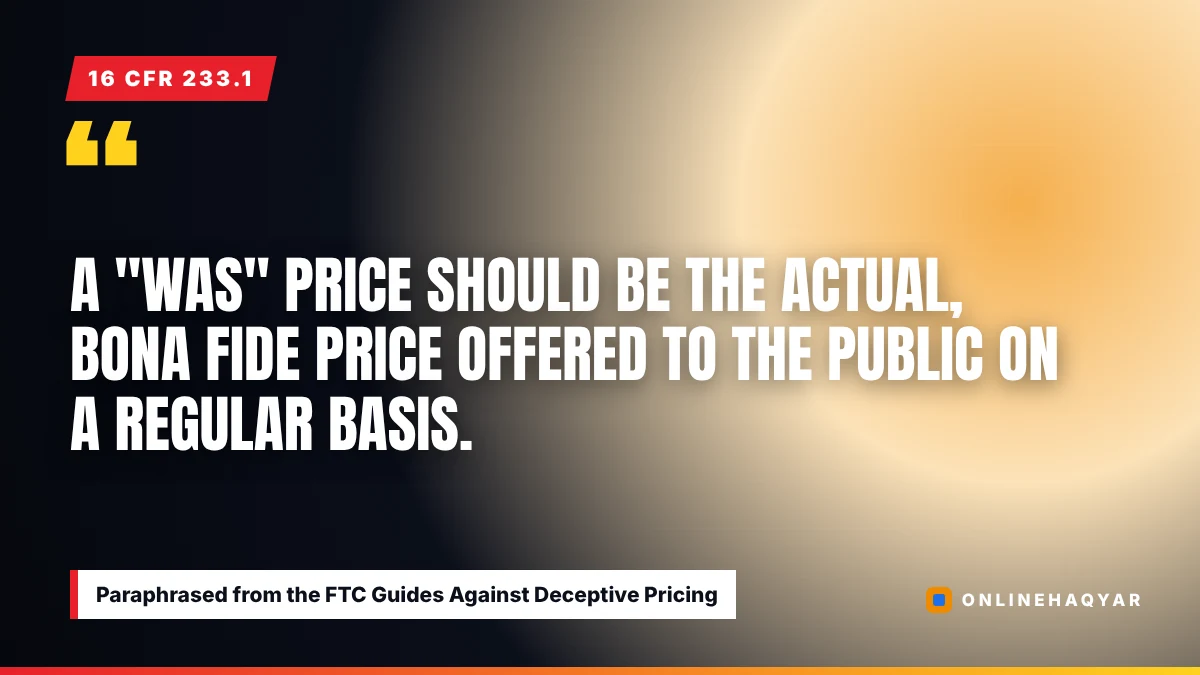
Official source (FTC Guides Against Deceptive Pricing, 16 CFR 233.1): A former-price comparison is meant to reflect “the actual, bona fide price at which the article was offered to the public on a regular basis” for a reasonably substantial period of time. If the higher price was never really the regular price, the guides call the comparison “fictitious”. (eCFR, 16 CFR Part 233)
The same section gives a simple example: claiming an item has been “Reduced to $9.99” when the former price was $10 is misleading, because the saving is too small to matter.
Official source (16 CFR 233.3): On manufacturer’s suggested retail or “list” prices, the guides note that “only in the rare case are all sales of an article at the manufacturer’s suggested retail or list price.”
Author’s analysis: In plain English, a crossed-out price should be a price people actually paid, recently and regularly. An MSRP or “compare at” figure is often just a reference number, not proof of a saving.
Are these rules enforced?
Source (U.S. Chamber of Commerce, June 2025): The Chamber states that the FTC “has not taken action to enforce these regulations since the Nixon administration”, and that some states, California in particular, see many deceptive-pricing lawsuits. (U.S. Chamber of Commerce)
Source (Consumers’ Checkbook, updated November 2025): Checkbook says that, to its knowledge, the FTC hasn’t enforced these rules “for decades”.
Author’s analysis: Whatever the legal position, you can’t rely on the label alone. Treat every “was” price, and every Black Friday discount built on it, as a claim to check, not a fact.
What a six-month price study found
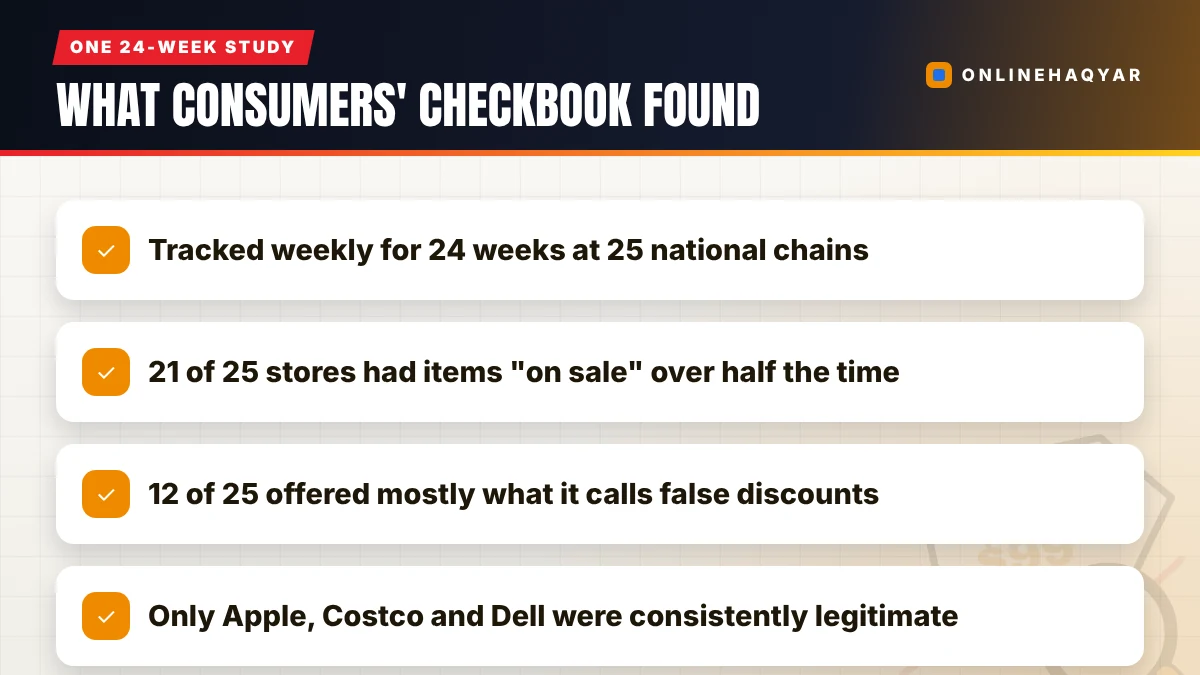
Source (Consumers’ Checkbook): Starting in February 2025, Checkbook’s researchers tracked prices once a week for 24 weeks at 25 national chains, covering 25 or more items per store. (Consumers’ Checkbook, “Sale Prices Are Usually Fake Discounts”)
- At 21 of the 25 stores, tracked items were advertised at sale prices more than half the time. In 2018, six retailers did so.
- For 12 of the 25 companies, more than half the tracked items were offered at what Checkbook calls false discounts.
- “Only Apple, Costco, and Dell consistently conducted legitimate discounts,” according to Checkbook.
- Checkbook also found that stores sometimes charged twice as much as competitors for the same product.
This is one study of a sample of products. It doesn’t tell you whether any specific deal you see today is genuine.
The 5-step Black Friday discount check
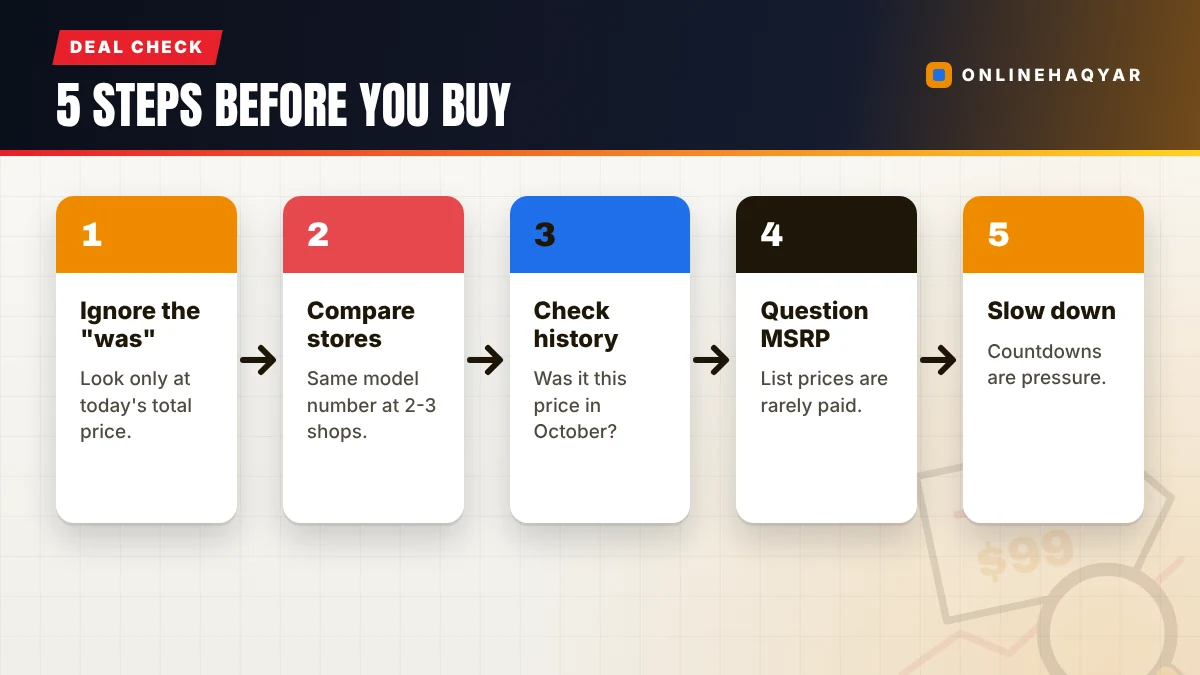
Run these steps before you buy anything expensive on Black Friday or Cyber Monday. Each one takes a minute or less, and together they tell you whether a Black Friday discount is a genuine saving.
1. Ignore the crossed-out price for a moment
Look only at the price you’d pay today, including shipping and tax. That’s the number to compare, because the size of a Black Friday discount means nothing if the starting price was inflated.
2. Compare the same model at two or three other stores
Search the exact model number, not just the product name. Author’s analysis: During big sales, TVs and appliances sometimes appear under slightly different model numbers at different retailers, which makes direct comparison harder. If the model numbers don’t match, compare features line by line. Source (Checkbook): “Shop around.”
3. Check the price history
Many shoppers use price-history charts from browser extensions or price-tracking websites to see what an item sold for over recent months. If today’s “sale” price matches what it cost for most of October, it isn’t a Black Friday saving. Before installing any extension, check what data it collects.
4. Treat MSRP, “list” and “compare at” prices with caution
Official source (16 CFR 233.3): List prices are often not what most sales happen at. Compare against real street prices from retailers you trust.
5. Don’t let a countdown rush you
Source (Checkbook): “Take your time” and “Don’t fall for manipulative tricks.” Checkbook also suggests asking for a price match if you find a lower price, and notes that stores may honour a sale price after its end date if you ask.
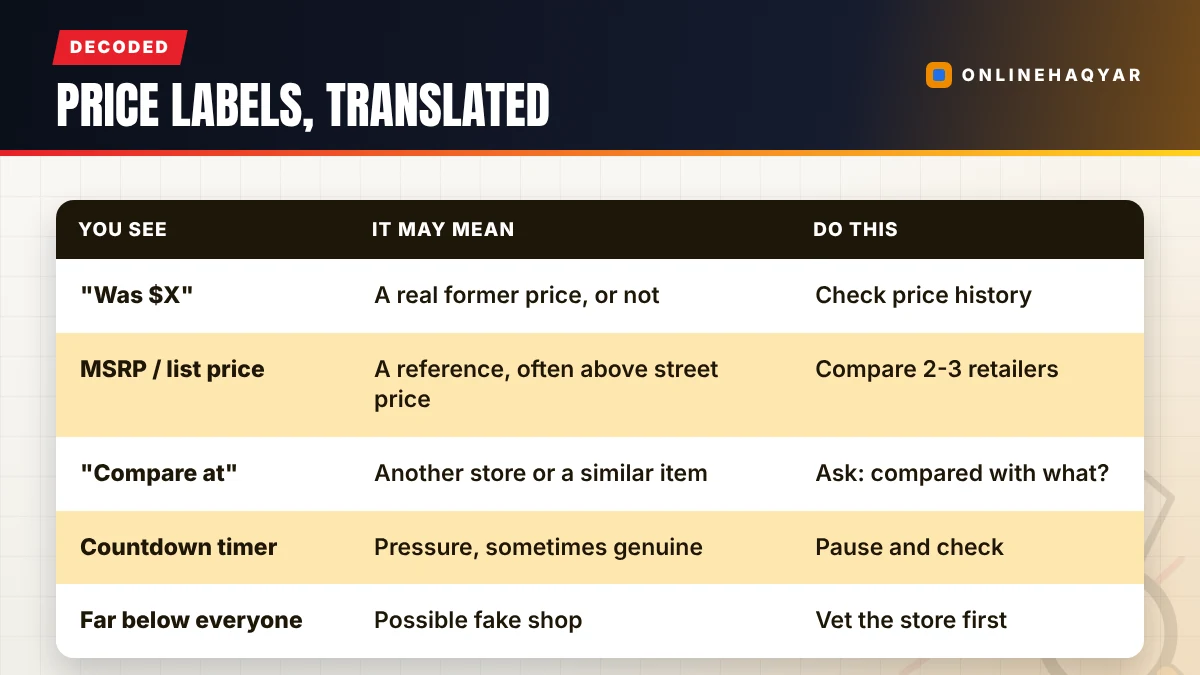
Price labels, decoded
| What you see | What it may mean | What to do |
|---|---|---|
| “Was $X” with no context | Possibly a real former price, possibly not | Check price history |
| “MSRP” or “List price” | Reference price, often above street price | Compare with 2-3 retailers |
| “Compare at” | Another store’s price, or a similar product | Ask “compared with what?” |
| Countdown timer | Pressure tactic, sometimes genuine | Pause and check before buying |
| Price far below every other store | Possibly a fake shop | Vet the store first |
That last row matters. A price far below every other retailer is a classic sign of a scam site, so use our guide on how to spot a fake online store before you pay. Glowing reviews on a deal page can be manufactured too; see how to spot fake reviews.
If the deal turns out to be fake after you buy
Author’s analysis: First, check the store’s return and price-adjustment policy, since many retailers extend return windows over the holidays. If the price drops again, ask about a price adjustment. If an item was misrepresented or never arrived, contact your card issuer about a dispute. US shoppers who believe a store’s pricing was deceptive can report it to the FTC at ReportFraud.ftc.gov.
A note on “pay in 4”: Splitting a purchase doesn’t make it cheaper. If a deal only feels affordable because of a buy now, pay later plan, read our buy now, pay later risks checklist before you click.
Frequently asked questions
Are Black Friday deals fake?
Not all of them. But one 2025 study found that most large retailers it tracked advertised “sales” more than half the time, so check each Black Friday discount rather than trusting the label.
What does “compare at” mean?
It’s a reference price chosen by the seller. Ask what it’s being compared with, and check real prices elsewhere.
Is MSRP the real price?
Not necessarily. US federal pricing guides note that few sales actually happen at list price.
Is a fake “was” price illegal?
US federal guides describe fictitious former prices as deceptive, and some states have their own rules. This article isn’t legal advice.
The bottom line
A real deal is a lower price than you’d normally pay, not a bigger number crossed out. Compare the exact model across stores, glance at its recent price history, and give yourself time. A genuine Black Friday discount will still look good after a five-minute check.