
Last updated: November 2026. Based on US Federal Trade Commission consumer and business guidance. Not legal advice. No affiliate links.
Star ratings drive millions of holiday purchases, and some of those stars aren’t real. Fake reviews are written to push you towards a product, or away from a competitor’s. Here’s how to weigh reviews sensibly, based on FTC guidance, and what US rules now say businesses can’t do.
The honest truth: you often can’t tell by reading
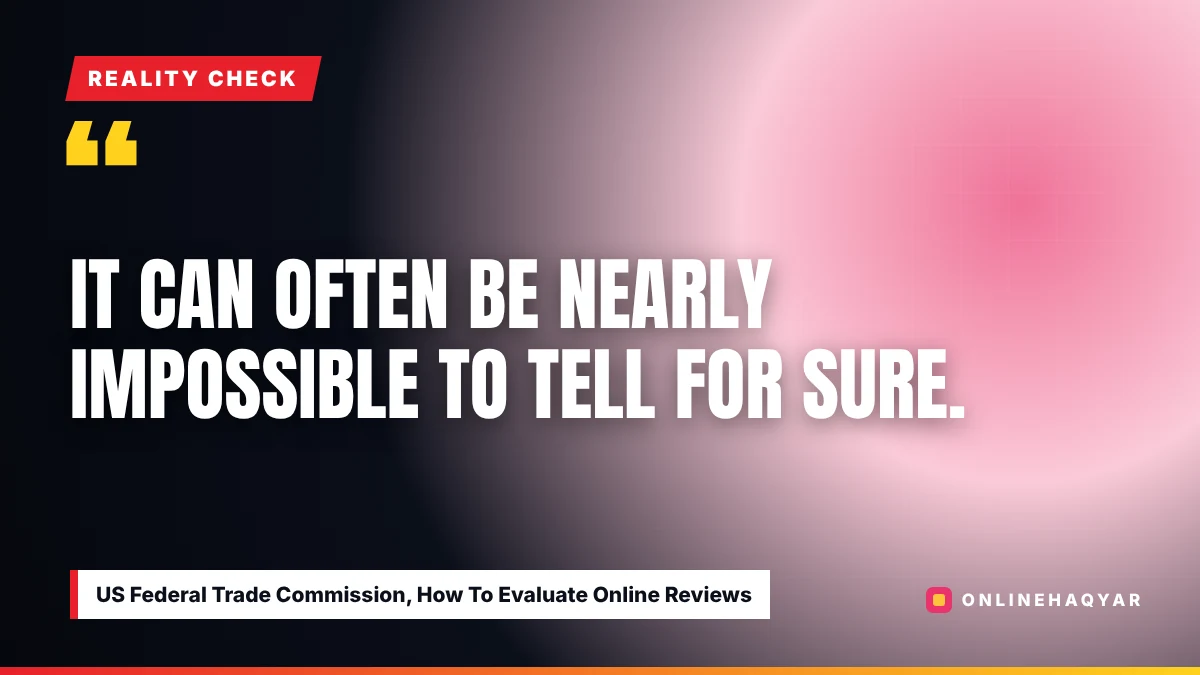
Official guidance (US FTC): The FTC warns that it “can often be nearly impossible to tell for sure” whether a review is fake just by reading it. Some fake positive reviews deliberately give fewer than five stars to look believable. Fake reviews aren’t always positive, either: a company might post fake negative reviews to damage a competitor. (FTC, How To Evaluate Online Reviews)
Author’s analysis: That’s why the checks below focus on patterns and sources rather than wording. Trying to spot “AI-sounding” text is unreliable, and genuine reviewers can sound stilted too.
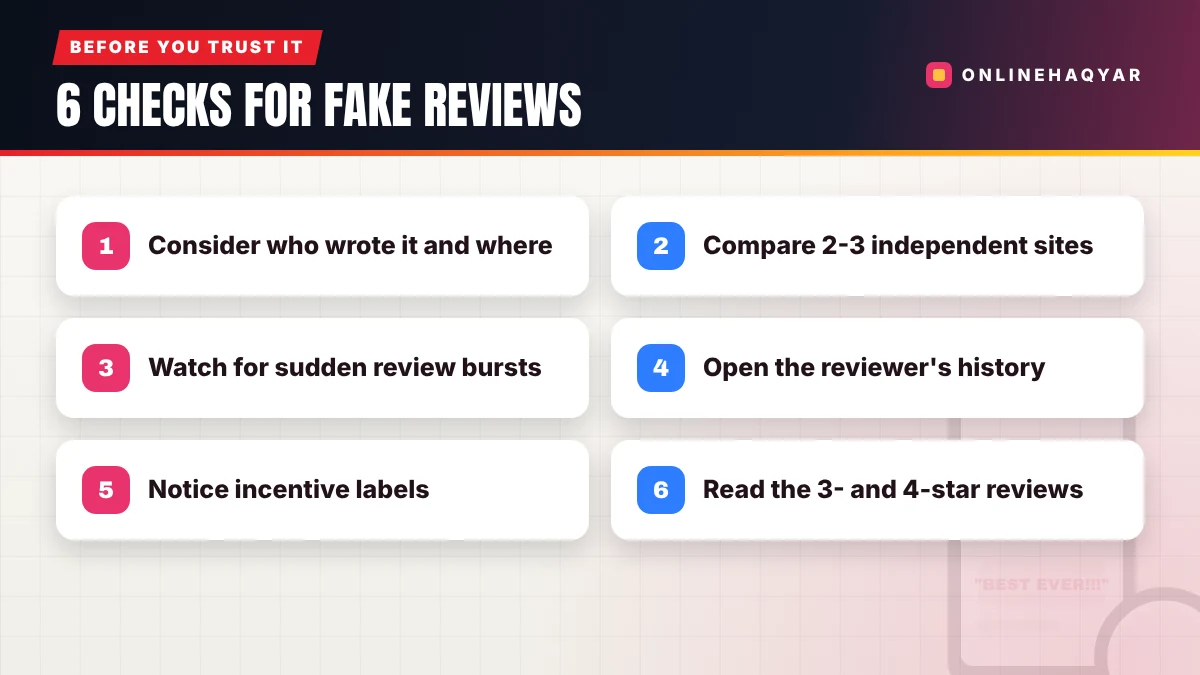
Six checks to spot fake reviews
1. Consider the source
Official guidance (FTC): Ask what you know about the reviewer and about the site or platform the review appears on.
Author’s tip: A review on the seller’s own website is marketing they chose to show you. Weigh it differently from one on an independent platform.
2. Use several sources
Official guidance (FTC): Well-known sites with “trustworthy and impartial expert reviews” are “still a very good place to start.”
Author’s tip: Look up the product on two or three independent sites plus a specialist forum or community, not only the store listing.
3. Check the timing
Official guidance (FTC): A “burst of reviews over a short period of time” can be a sign of fakes.
Author’s tip: Sort reviews by “newest” and scroll back. Dozens of glowing reviews in one week, followed by silence, deserve suspicion.
4. Look at the reviewer’s history
Official guidance (FTC): If an account seems to exist only to review one product, that review may be fake.
Author’s tip: Click through to the reviewer’s profile where the platform allows it. A real person usually reviews a mix of things over time.
5. Notice incentive labels
Official guidance (FTC): Some sites label reviews from people who received a free product or another incentive. How you weigh those reviews “is up to you”, the FTC says.
Author’s opinion: Read them, but give more weight to unlabelled, verified-purchase reviews that describe specific use over weeks or months.
6. Read the middle, not the extremes
Author’s tip (not FTC guidance): Three- and four-star reviews often contain the most useful detail about real limitations, such as sizing, battery life or customer service. If every review is either five stars or one star, be cautious.
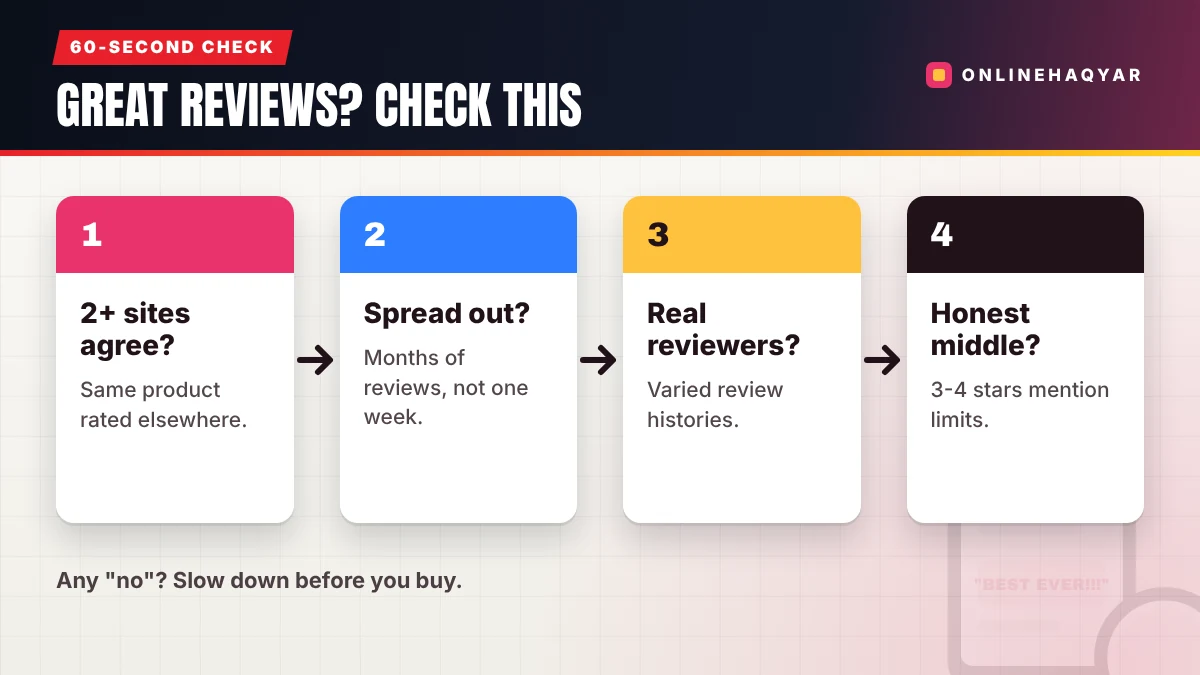
A 60-second review check
Found a product with great reviews?
  -> Same product rated on 2+ independent sites?   No -> slow down
  -> Reviews spread over months, not one week?     No -> slow down
  -> Reviewers have other, varied reviews?         No -> slow down
  -> 3-4 star reviews mention real limitations?    Yes -> good sign
Author’s analysis: Fake reviews and fake shops often travel together. A brand-new store with hundreds of perfect reviews and prices far below everyone else is a classic combination; our guide to spotting a fake online store shows how to check the shop itself. And if glowing reviews are pushing a “limited-time” price, use our Black Friday discount check to see whether the saving is real.
What the FTC’s rule bans (since October 2024)
Official source (FTC): The FTC’s Consumer Reviews and Testimonials Rule “went into effect on October 21, 2024.” It “authorizes courts to impose civil penalties for knowing violations.” (FTC, Consumer Reviews and Testimonials Rule: Questions and Answers)
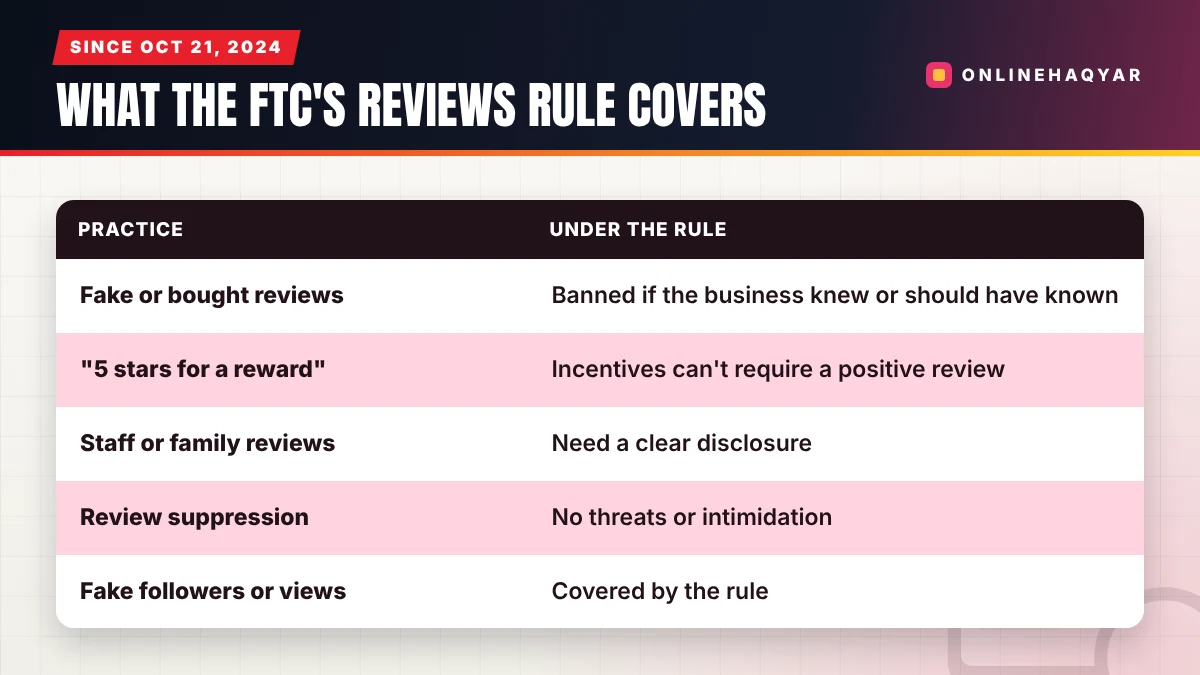
Official source (FTC), summarised: The rule covers:
- Fake or false reviews and testimonials. A business can be liable for writing or buying reviews it “knew or should have known were false.”
- Conditional incentives. Businesses may offer incentives for reviews, but may not require or imply that the review must be positive (or negative).
- Insider reviews. Reviews by company insiders need a clear and conspicuous disclosure of the relationship.
- Company-controlled “independent” review sites. A business can’t misrepresent a site it controls as providing independent reviews.
- Review suppression. Businesses can’t use intimidation or unfounded legal threats to stop or remove reviews.
- Fake social-media indicators. The rule also covers fake indicators of social-media influence, such as bought followers or views.
Author’s analysis: The rule targets businesses and review sellers, not shoppers. For you, the practical takeaway is that a business offering a reward “for a 5-star review” is asking for something US rules prohibit. That’s a good reason to doubt its other reviews.
For small businesses: collect reviews the right way
Official source (FTC): Asking customers for reviews and offering incentives is allowed, as long as you don’t require or suggest a particular rating. Reviews from staff and family need a clear disclosure.
Author’s analysis: a simple compliant routine
- Ask every customer for a review, not only the happy ones.
- If you offer an incentive, offer it for “an honest review”, whatever the rating.
- Don’t write reviews yourself or ask friends to, unless they disclose the connection.
- Reply calmly to negative reviews, and never threaten reviewers.
Where to report suspected fake reviews
First, use the platform’s own “report” button, which is usually the fastest route to removal. In the US, you can also report deceptive business practices to the FTC at ReportFraud.ftc.gov.
If fake reviews led you into a scam that asked for gift cards, read our guide to gift card scams for what to do next.
Frequently asked questions
Can you tell if a review is fake by reading it?
Often not. The FTC says it can be “nearly impossible to tell for sure”, which is why checking patterns, timing and sources works better.
Are fake reviews illegal in the US?
The FTC’s Consumer Reviews and Testimonials Rule, in effect since October 21, 2024, prohibits businesses from creating or buying fake reviews, among other practices.
Can businesses pay for reviews?
They can offer incentives, but they can’t require or imply a positive or negative review, according to the FTC.
Are negative reviews ever fake?
Yes. The FTC notes that companies may post fake negative reviews about competitors.
The bottom line
You usually can’t spot fake reviews from the wording alone. Compare several independent sources, look for sudden bursts, check reviewer histories and read the middle-star reviews. Since October 2024, US rules ban fake reviews, conditional incentives and undisclosed insider reviews, so a business asking for “5 stars for a gift card” is a red flag in itself.