
Last updated: November 2026. Educational content, not financial advice. Always read your plan’s own terms. No affiliate links.
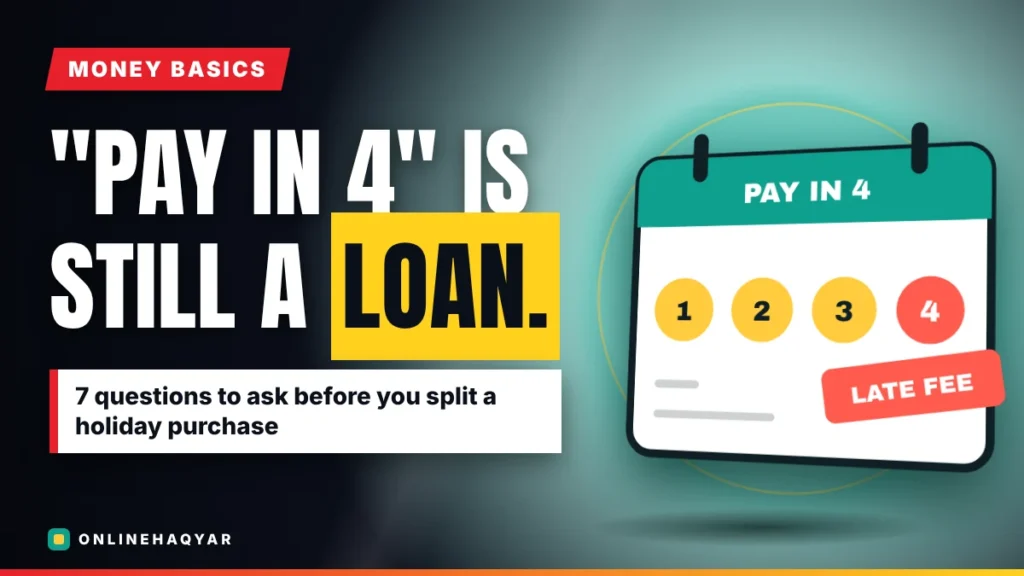
At checkout this season you’ll see it everywhere: “Pay in 4 interest-free payments.” Buy now, pay later (BNPL) can be a convenient way to spread a purchase, but it works differently from a credit card, and those differences matter most when something goes wrong: a late payment, a return, a faulty item or a fake shop.
Here are seven questions to ask before you click, what US regulators say, and a one-minute rule to keep holiday spending under control.
What buy now, pay later actually is
BNPL is a short-term loan, usually split into a small number of instalments. Official source (CFPB): The Consumer Financial Protection Bureau describes these as payments over “four or fewer” instalments, and notes that most don’t charge interest but most do charge late fees. Your agreement is with the BNPL lender, not the store. (CFPB, 2021, archived)
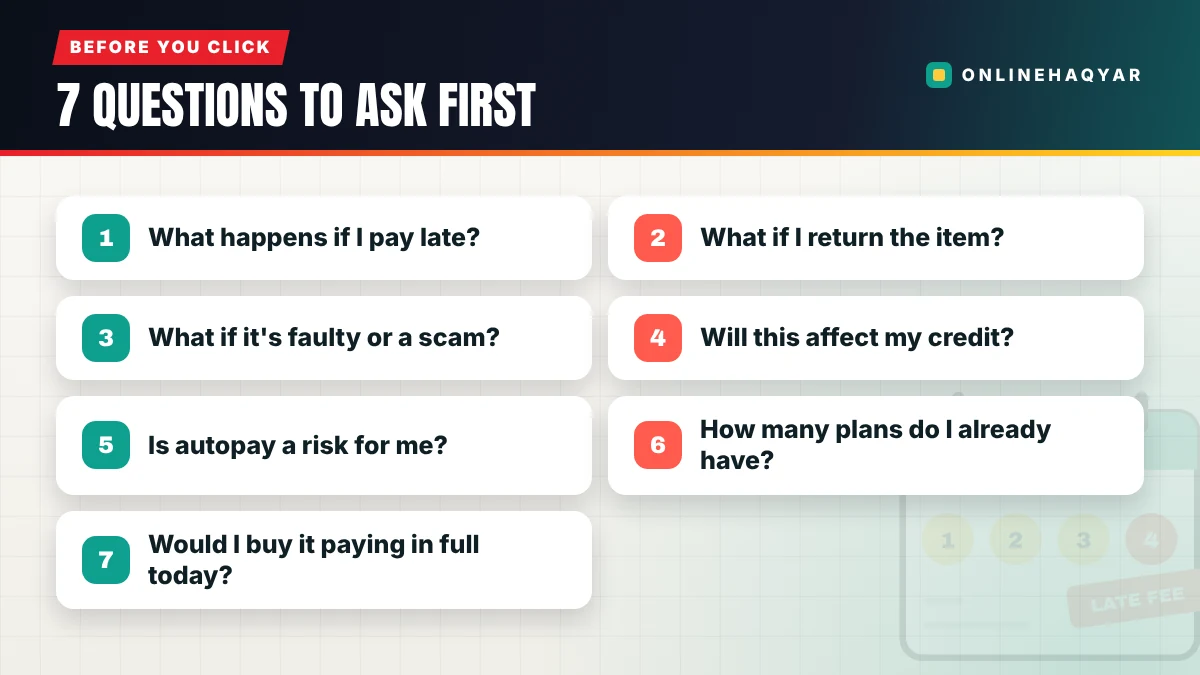
7 questions to ask before using buy now, pay later
1. What happens if I pay late?
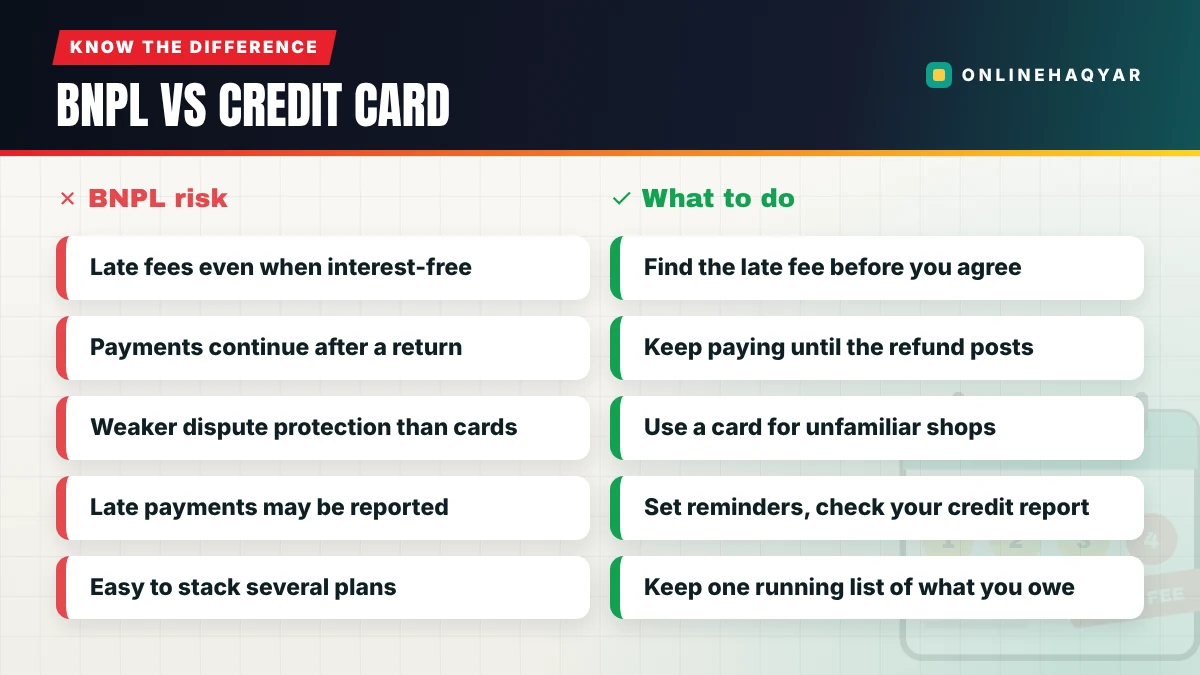
“Interest-free” isn’t the same as “fee-free”. Official guidance (FTC): “Many plans charge high late fees, per-transaction fees, or change fees, among others.” Find the late-fee amount in the terms before you agree. (FTC consumer alert, updated May 22, 2024)
2. What if I return the item?
This surprises many people. Official source (CFPB): “Even if you return the item, you may need to continue paying back your BNPL loan” until the return is processed and credited. Keep paying on schedule until the lender confirms the refund.
3. What if the item never arrives, is faulty or is a scam?
Official source (CFPB): “BNPL loans don’t offer the same dispute protections as credit cards if the item you purchase is faulty or a scam.”
Author’s analysis: For an unfamiliar online store, a credit card may give you more ways to get your money back. Before using any payment method with a shop you don’t know, run our 7-point check to spot a fake online store.
4. Will this affect my credit?
It depends on the provider. Official guidance (FTC): Some providers report payment history to the three nationwide credit bureaus, so a late or missed payment “could hurt your credit score”, and some run a credit check. Official source (CFPB): If an unpaid loan goes to a debt collector, it could be reported. You can check your free credit reports at AnnualCreditReport.com, the site the FTC points to.
5. Is autopay going to cause a problem?
Autopay can help you avoid late fees, but the CFPB reminds borrowers to keep enough money in the linked account when payments are due.
Author’s analysis: If your account could run low around payday, an autopay pull might trigger your bank’s own overdraft or returned-payment fees. Check your bank’s policy.
6. How many buy now, pay later plans do I already have?
Source (U.S. PIRG Education Fund): “We’re seeing people overcommit by taking out too many loans at a time.” (PIRG, 2026)
Author’s analysis: Four small payments feel easy. Four plans with four payments each, falling every two weeks across different apps, are much harder to track.
7. Would I buy this if I had to pay in full today?
Official source (CFPB): BNPL can tempt people to spend more than they otherwise would, so check your budget first. If the honest answer is “no”, BNPL isn’t saving you money. It’s delaying the decision.
Buy now, pay later vs a credit card
Author’s analysis: Neither is automatically better. A credit card that you pay off in full each month offers stronger dispute rights and no interest. A credit card balance you carry can cost far more than a BNPL plan you repay on time. The right choice depends on your habits, so compare the real risks:
| Risk | Buy now, pay later | Credit card (paid in full) |
|---|---|---|
| Interest | Often none on “pay in 4” plans | None if paid in full by the due date |
| Late fees | Common (CFPB) | Common |
| Disputes for faulty or scam purchases | Weaker than cards (CFPB) | Dispute rights for billing errors and non-delivery (FTC) |
| Returns | You may need to keep paying until the refund posts (CFPB) | Refund is credited to the card |
The one-minute rule for holiday BNPL
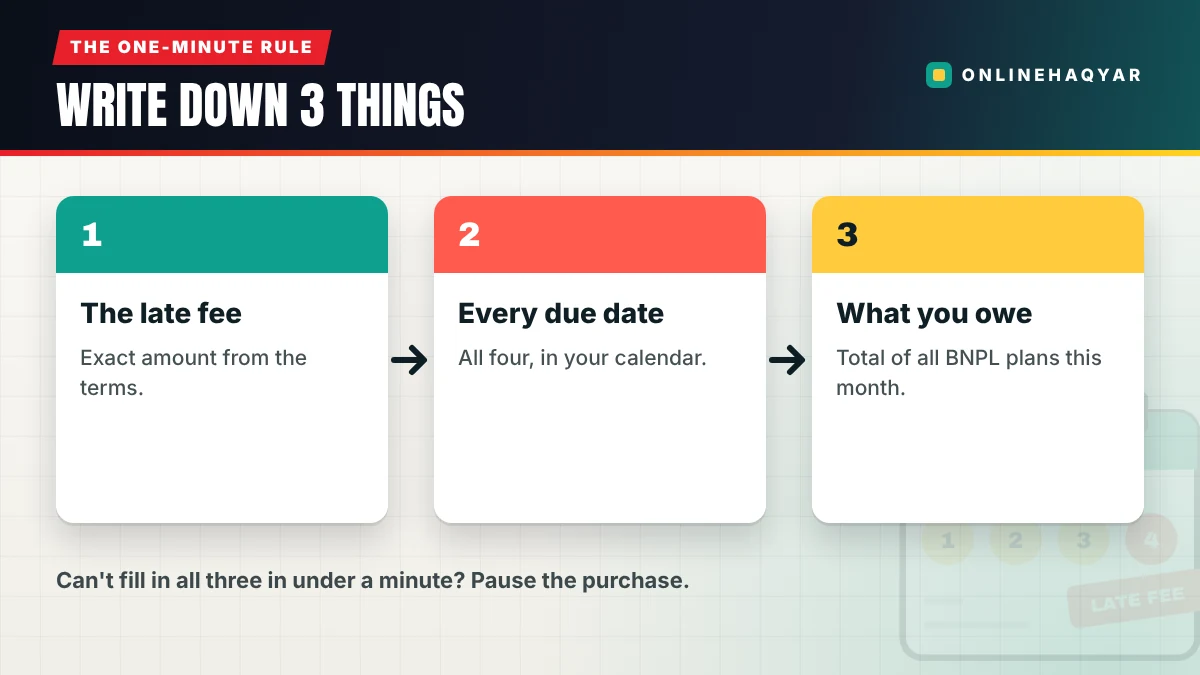
Author’s suggestion: Before you click “Pay in 4”, write down three things:
- The late fee, in dollars, from the plan’s terms.
- Every due date, added to your calendar.
- The total of all BNPL payments you already owe this month.
If you can’t fill in all three in under a minute, pause the purchase. And if a “deal” only feels affordable because it’s split into four, check whether the discount is even real with our Black Friday discount check.
Where buy now, pay later rules stand in the US
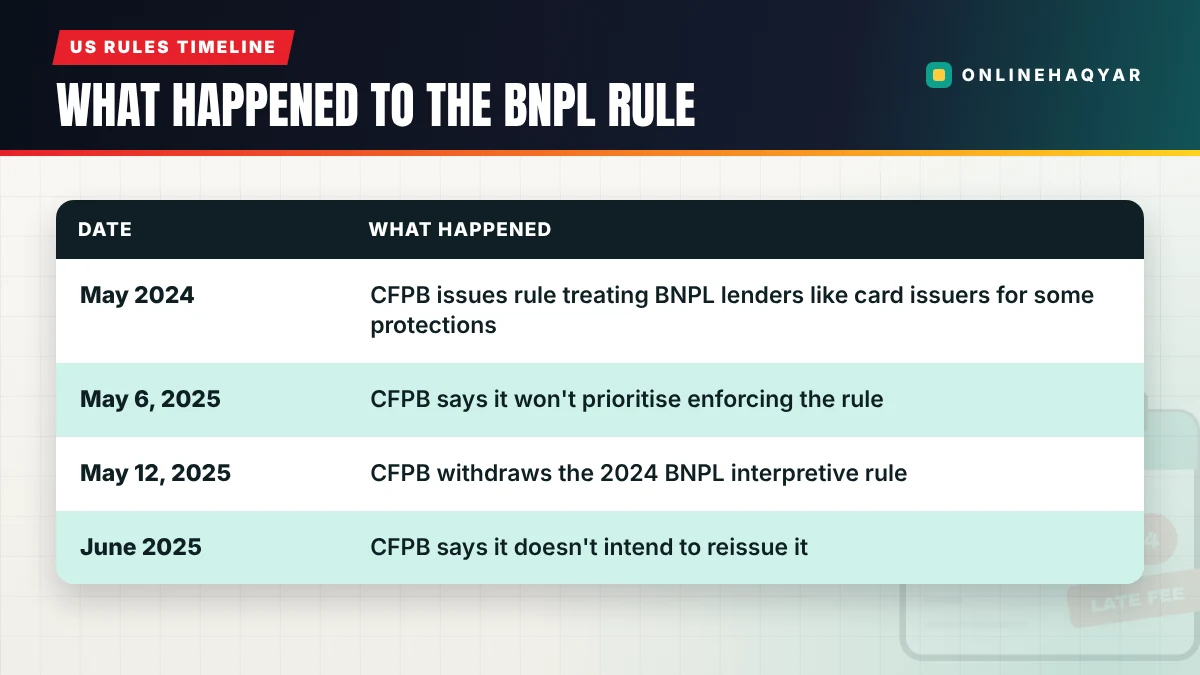
- May 2024: The CFPB issued an interpretive rule treating BNPL lenders like credit card providers for certain protections. The FTC updated its consumer alert on May 22, 2024 to reflect it.
- May 6, 2025: According to law firm Holland & Knight, the CFPB announced it “will not prioritize enforcement actions” based on that rule.
- May 12, 2025: Official source (CFPB): “The CFPB withdrew several guidance documents, including the 2024 BNPL Interpretive Rule.” (CFPB, BNPL products)
- June 2025: In a court status report, the CFPB said it “does not intend to reissue the BNPL Interpretive Rule”, as reported by Ballard Spahr’s Consumer Finance Monitor.
Author’s takeaway: Don’t assume credit-card-style dispute rights at the federal level. Read your provider’s own dispute and refund terms. Some states have been developing their own BNPL rules, so check with your state’s financial regulator if this matters for a big purchase.
Frequently asked questions
Is buy now, pay later interest-free?
Many “pay in 4” plans are, but most charge late fees and some charge other fees, according to the CFPB and FTC.
Can buy now, pay later hurt my credit score?
It can if your provider reports late or missed payments, or if an unpaid balance goes to collections (FTC, CFPB).
Do I keep paying if I return something?
Possibly, until the refund is processed. The CFPB advises continuing to pay on schedule.
Can I dispute a BNPL charge like a credit card charge?
The CFPB says BNPL doesn’t offer the same dispute protections as credit cards, and the 2024 federal rule that aimed to change that was withdrawn in May 2025. Check your provider’s terms.
Watch for scams that use “easy payment”
Scammers like any payment method that’s quick and hard to reverse. If a seller pushes you towards gift cards instead, that’s a scam by definition; see our guide to gift card scams.
The bottom line
Buy now, pay later isn’t automatically good or bad. It’s a loan with its own rules on fees, returns and disputes. Ask the seven questions, keep a running list of what you owe, and use a credit card or cash when protection or simplicity matters more than splitting the payment.