

Last updated: November 2026. General information for US readers, not financial, tax or legal advice. Based on Social Security Administration and CMS pages read in November 2026. No affiliate links.
Social Security benefits rise 3.6% in 2027. The Social Security COLA (cost-of-living adjustment) is the headline, but it isn’t the whole story. The same announcement changes how much you can earn before benefits are withheld, how much of your pay is taxed for Social Security, and how much SSI recipients receive.
This guide puts every 2027 figure in one place, explains when the money and the notices arrive, and gives you a short checklist for December.
The Social Security COLA for 2027 at a glance
Official source (SSA press release, October 14, 2026): The Social Security Administration announced “a 3.6 percent benefit increase for 2027.” It says retirement benefits will rise “by $75 per month” on average.
Official source (SSA 2027 COLA fact sheet): The fact sheet estimates the average retired worker’s benefit at $2,095 a month before the COLA and $2,170 after it, in January 2027.
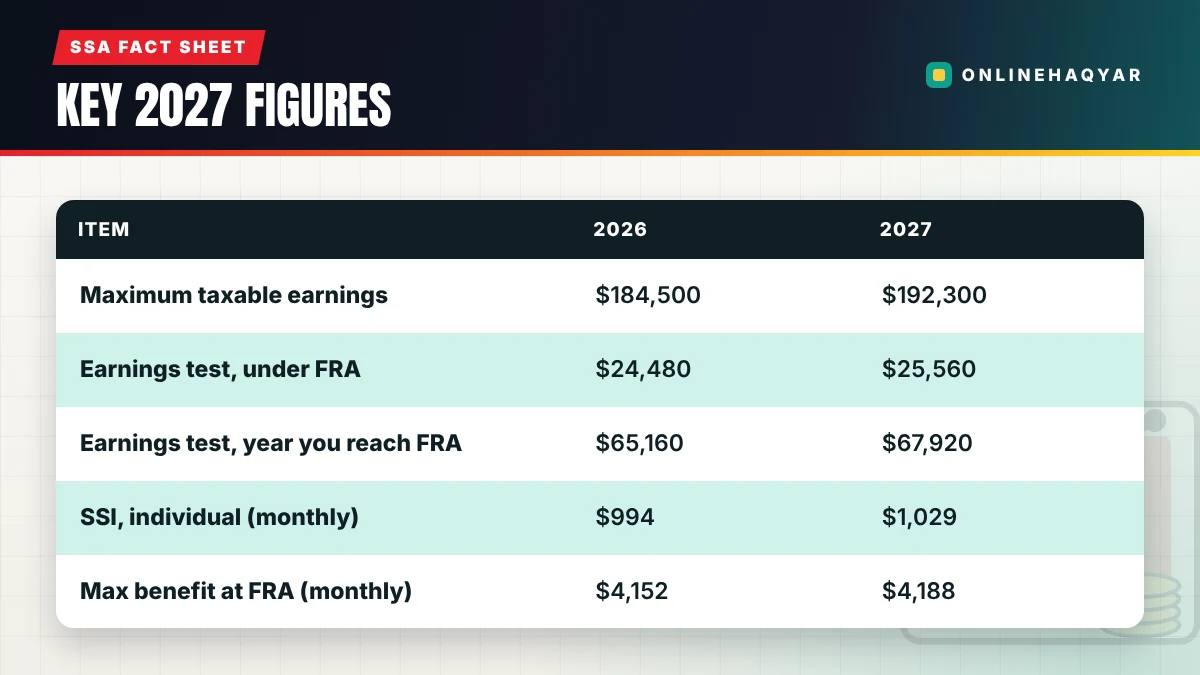
| Item | 2026 | 2027 |
|---|---|---|
| Cost-of-living adjustment | – | 3.6% |
| Maximum taxable earnings | $184,500 | $192,300 |
| Earnings test, under full retirement age (yearly) | $24,480 ($2,040/month) | $25,560 ($2,130/month) |
| Earnings test, year you reach full retirement age (yearly) | $65,160 ($5,430/month) | $67,920 ($5,660/month) |
| Quarter of coverage | $1,890 | $1,970 |
| SSI federal payment, individual (monthly) | $994 | $1,029 |
| SSI federal payment, couple (monthly) | $1,491 | $1,544 |
| Maximum benefit, worker retiring at full retirement age (monthly) | $4,152 | $4,188 |
Author’s analysis: The $75 figure is an average, and the Social Security COLA is a percentage. Your own raise is 3.6% of your current benefit, so a $1,500 benefit rises by about $54 before any Medicare deduction ($1,500 × 0.036). Your notice shows the exact, rounded amount.
When the Social Security COLA shows up
Official source (SSA press release):
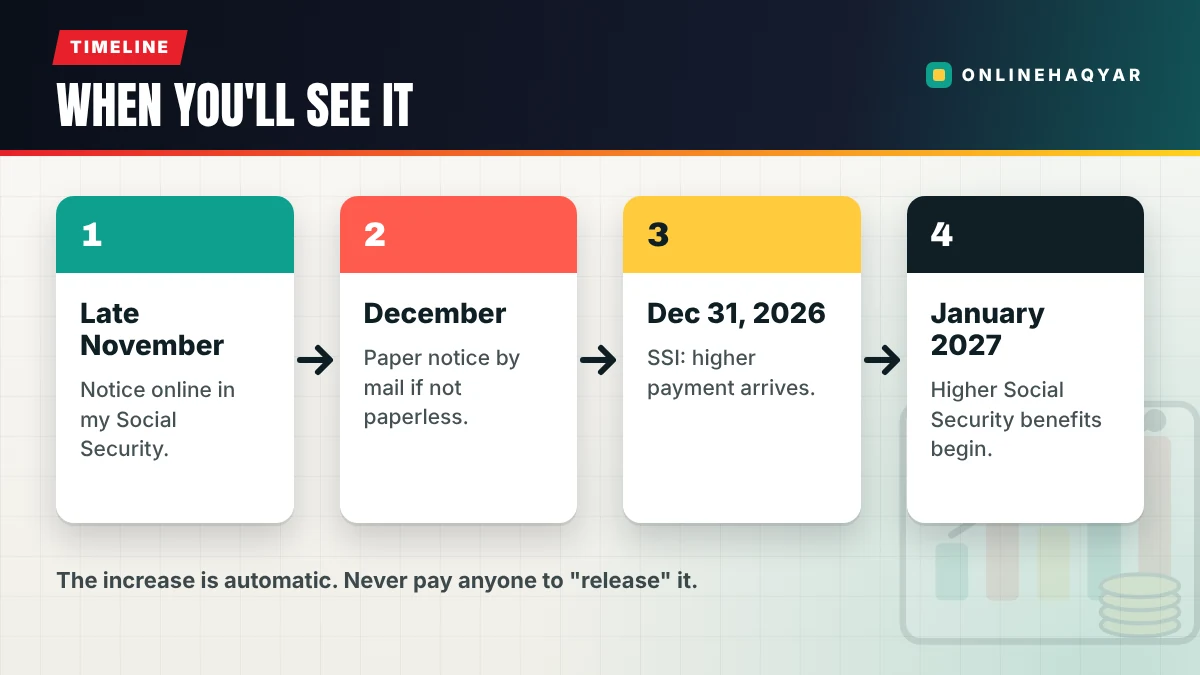
- Social Security beneficiaries receive the 3.6% COLA “beginning in January 2027.”
- SSI payments increase starting “on December 31, 2026.”
Author’s analysis: For SSI recipients, the timing of the Social Security COLA can be confusing. The new amount arrives at the very end of December, which can look like two payments in one month. It’s the January payment arriving early, not a bonus. Budget it for January.
How to see your new benefit amount
Official source (SSA press release):
- If you have a my Social Security account, you can view your COLA notice online “starting in late November, up to three weeks earlier than receiving a paper notice in the mail.”
- If you aren’t signed up for paperless notices, your COLA notice arrives by mail in December. The deadline to opt in to paperless notices for this year was November 18.
- Medicare enrollees can see their 2027 premium amount in the my Social Security Message Center starting in late November.
Author’s opinion: Log in rather than waiting for the letter. Your notice shows both the new gross benefit and any Medicare deduction, which together decide what actually lands in your bank account.
Watch out for COLA scams
Author’s tip: The Social Security COLA is applied automatically. Be wary of any call, text or email that offers to “release” or “speed up” your raise for a fee, or that asks you to confirm your Social Security number. If you’ve already clicked a link, our guide on what to do if you clicked a phishing link walks you through the next steps. Scammers also use urgent calls that sound like relatives; see our explainer on the AI voice-cloning family emergency scam.
Still working? The 2027 earnings test
If you claim benefits before your full retirement age (FRA) and keep working, part of your benefit can be withheld.
Official source (SSA 2027 COLA fact sheet):
- Under FRA for all of 2027: the limit is $25,560 a year. “One dollar in benefits will be withheld for every $2 in earnings above the limit.”
- Reaching FRA in 2027: the limit is $67,920 a year. It applies only to earnings for months before you reach full retirement age, and $1 is withheld for every $3 above the limit.
- From the month you reach FRA: there is no limit.
Author’s analysis (worked example): Maria is 64 for all of 2027 and expects to earn $31,560. That’s $6,000 over the limit, so about $3,000 in benefits would be withheld ($6,000 ÷ 2).
Official source (SSA Benefits Planner): Withheld benefits aren’t simply lost. SSA’s page on working while receiving benefits says that once you reach full retirement age, “We will recalculate your benefit amount to give you credit for the months we reduced or withheld benefits.”
Author’s opinion: Before you cut your hours to stay under the limit, ask SSA how the recalculation would work in your case.

Workers: the taxable maximum and quarters of coverage
Official source (SSA fact sheet): The maximum earnings subject to Social Security tax rise to $192,300 in 2027, up from $184,500. Earning one credit, called a “quarter of coverage”, takes $1,970 in earnings, up from $1,890. There is no maximum for Medicare (HI) taxable earnings.
Author’s analysis: If you earn more than $192,300 in 2027, the earnings above that amount aren’t subject to Social Security tax, though Medicare tax still applies. If you also save in a workplace plan, our guide to the 2027 401(k) and IRA limits covers next year’s savings figures.
SSI: new federal payment amounts
Official source (SSA fact sheet): The federal SSI payment standard rises to $1,029 a month for an individual and $1,544 for a couple.
Author’s analysis: Your actual SSI payment may be lower (because of other income) or higher (if your state adds a supplement). Treat the federal figure as a ceiling, not a promise.
What about Medicare premiums?
Official source (CMS fact sheet, November 17, 2026): The standard Medicare Part B premium is $209.40 a month in 2027, up $6.50 from $202.90.
Author’s analysis: If your Part B premium is taken from your benefit at the standard rate, your net change is your COLA minus $6.50. Using SSA’s $75 average, that’s roughly $68.50 more a month, but your figure depends on your own benefit and premium. Higher-income enrollees pay more; see our Medicare Part B premium 2027 guide for the income brackets.
Your December checklist
Author’s opinion:
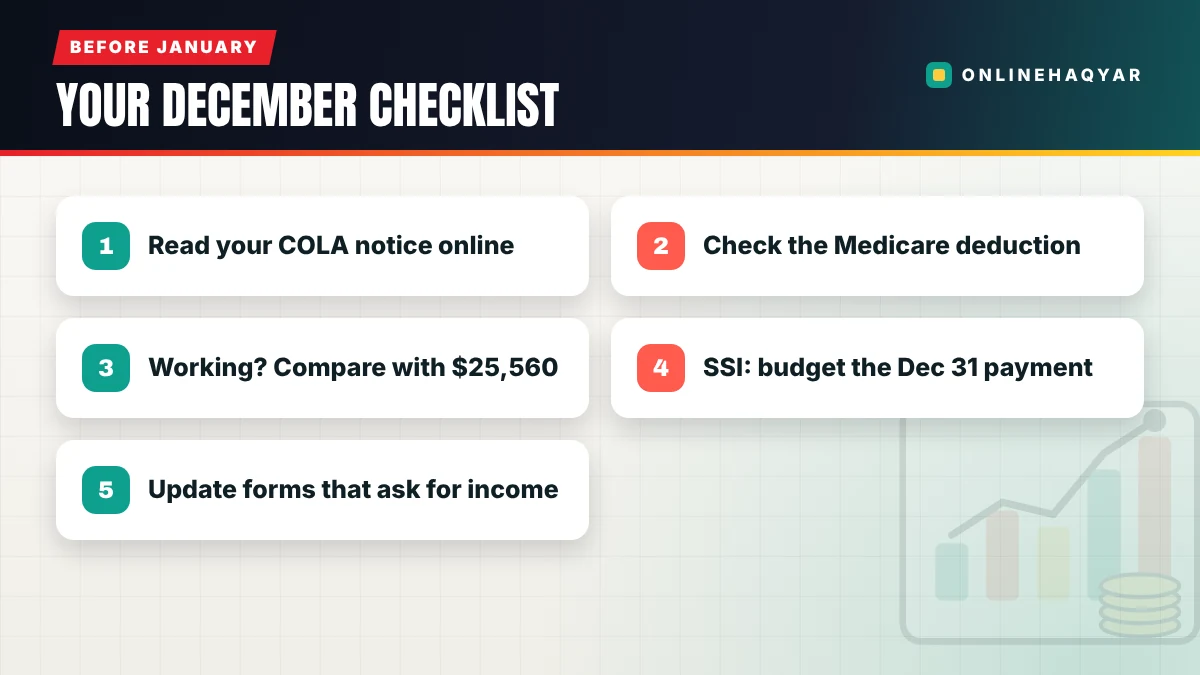
- Log in to my Social Security in late November and read your COLA notice.
- Check the Medicare deduction and your net payment.
- Under FRA and still working? Compare your expected 2027 earnings with $25,560 (or $67,920 if you reach FRA in 2027).
- Receiving SSI? Expect the January payment on December 31 and budget for it.
- Update any household budget, rent-assistance or benefit forms that ask for your income.
Frequently asked questions
What is the Social Security COLA for 2027?
3.6%, according to the Social Security Administration.
When does the 2027 increase start?
January 2027 for Social Security benefits, and December 31, 2026 for SSI payments.
How much will my check go up?
By 3.6% of your current benefit. SSA estimates retirement benefits rise by $75 a month on average. Any Medicare premium change comes off that.
What is the 2027 earnings limit?
$25,560 a year if you’re under full retirement age all year, and $67,920 in the year you reach it.
What is the 2027 Social Security wage base?
$192,300.
The bottom line
The 2027 Social Security COLA is 3.6%, about $75 a month for the average retiree. The changes that catch people out are the quieter ones: the earnings test for early claimants, the higher taxable maximum for workers and the Medicare deduction that trims the raise. Read your notice, check the net amount and adjust your budget before January.