
Last updated: November 2026. General information for US taxpayers, not financial, tax or legal advice. Tax rules change; check IRS.gov or a qualified tax professional for your situation. No affiliate links.
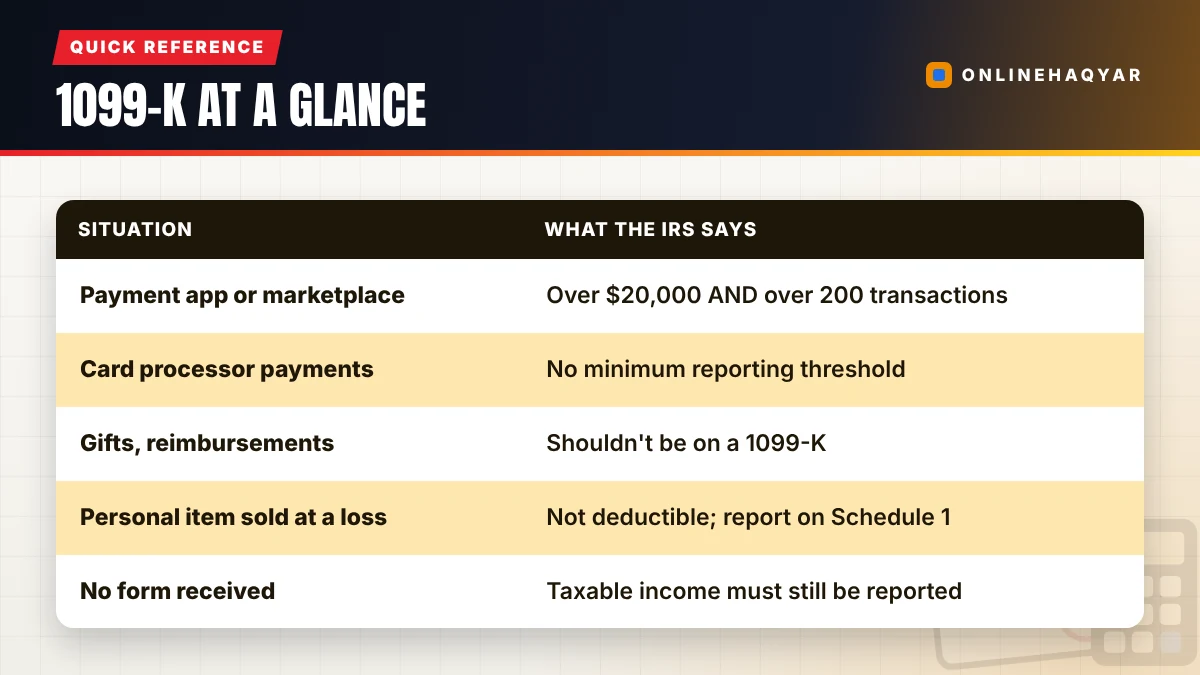
If you sell online, freelance or get paid through a payment app, you may have heard that the IRS would send a Form 1099-K for as little as $600. That plan has changed. The 1099-K threshold for payment apps and online marketplaces is back to more than $20,000 and more than 200 transactions.
Here’s what the 1099-K threshold is now, what it doesn’t change, and what to do if you get a form you didn’t expect.
The 1099-K threshold in one sentence
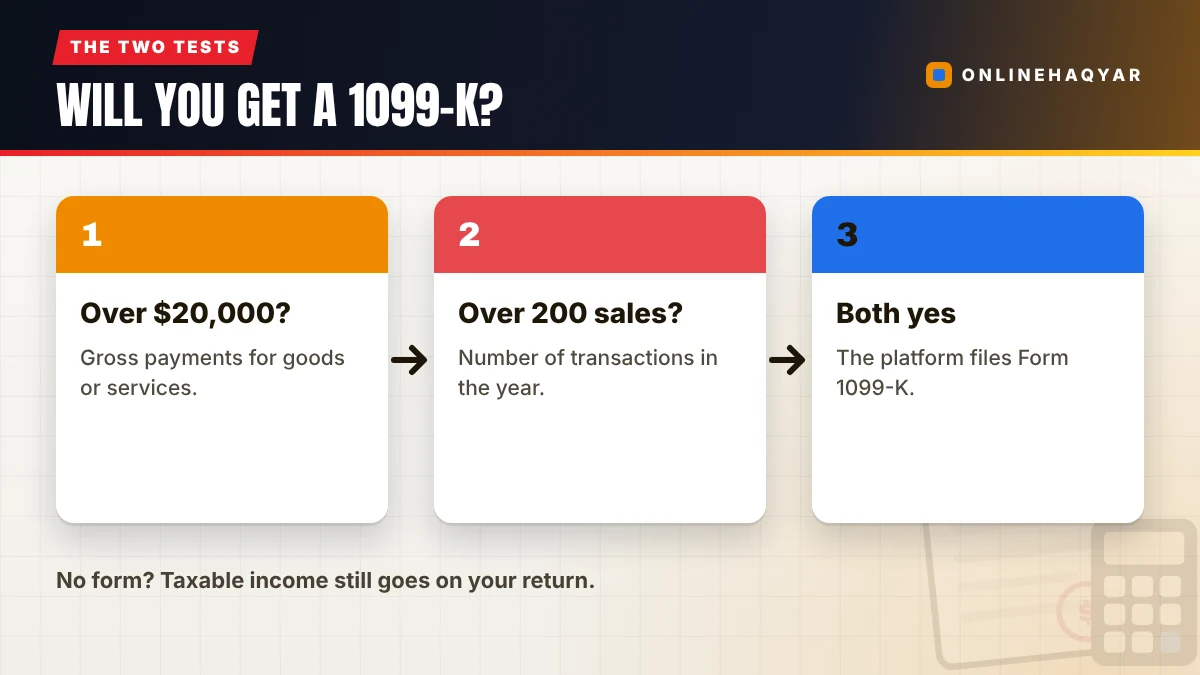
Official source (IRS Form 1099-K FAQs): A payment app or online marketplace (the IRS calls it a “third party settlement organization”, or TPSO) is not required to file Form 1099-K “unless the gross amount of reportable payment transactions to a payee exceeds $20,000” and “the number of transactions exceeds 200.”
Both conditions must be met: more than $20,000 and more than 200 transactions in the calendar year. The IRS instructions for Form 1099-K apply the test “for the calendar year”.
Official source (IRS FAQs): The One, Big, Beautiful Bill “retroactively reinstated the reporting threshold in effect prior to the passage of the American Rescue Plan Act of 2021 (ARPA).” You can read the background in the IRS Form 1099-K general FAQs.
Author’s analysis: The IRS pages we read describe the change as retroactive but don’t list specific tax years. If you received a 1099-K for an earlier year under the old, lower threshold, check the current guidance on the IRS About Form 1099-K page before you file or amend anything.
Card payments are different
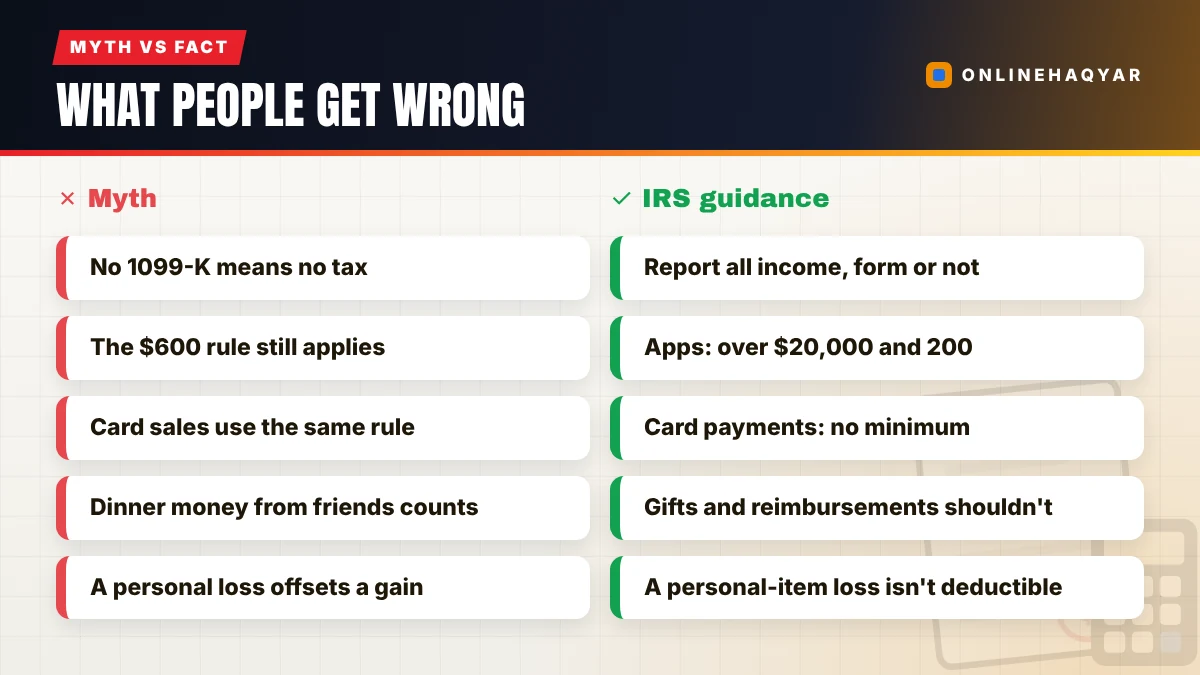
Official source (IRS Form 1099-K FAQs): For payment card transactions, for example when customers pay you by credit or debit card through a card processor, there is “no minimum reporting threshold”. The $20,000 / 200 rule applies to payment apps and online marketplaces.
Author’s analysis: The 1099-K threshold doesn’t protect card sales. If you take card payments through a card terminal or processor, expect a 1099-K regardless of how small your sales are. Your records should match what the processor reports.
What did NOT change: income is still taxable
This is the part most people miss.
Official source (Taxpayer Advocate Service): “There is no change to the taxability of income.”
Official source (IRS FS-2026-07): Taxpayers “must report all income when they file their tax return regardless of whether they receive a Form 1099-K or other information return.”
Official source (Taxpayer Advocate Service): Self-employment tax generally applies when net earnings from self-employment are $400 or more.
Author’s analysis: The higher 1099-K threshold changes when a form is sent, not what you owe. A seller making $8,000 a year through a marketplace may never see a 1099-K, but that profit still belongs on the tax return.
Personal payments should not be on a 1099-K
Official source (IRS FAQs): Money sent between family and friends that isn’t payment for goods or services “should not be reported on a Form 1099-K.” Payments for gifts and reimbursements shouldn’t be reported either.
Official source (Taxpayer Advocate Service): Expense sharing is a common cause of incorrect 1099-Ks.
Author’s tip: Even with the higher 1099-K threshold, a wrong form is still possible once you pass it. Practical habits, based on IRS and Taxpayer Advocate guidance:
- Ask friends and family to mark personal payments as personal in the app, where that option exists.
- Note the purpose and sender of payments you receive.
- Keep business and personal payments separate, ideally in separate accounts.
- Keep records: invoices, receipts, and what you originally paid for items you resell.
If you invoice clients, our freelance invoice guide shows how to keep records that make tax time easier.
Selling personal items at a loss
Official source (Taxpayer Advocate Service): Gain or loss is generally the difference between what you paid for an item and what you sold it for. A gain is taxable and is reported on Form 8949 and Schedule D. “A loss is not deductible, but it still needs to be reported on Schedule 1.”
Example (adapted from the IRS FAQ example about tickets): You sell one concert ticket for more than you paid (a gain) and another for less (a loss). The gain goes on Form 8949 and Schedule D. The loss is reported in the entry space at the top of Schedule 1 and can’t be used to offset the gain.
Got a 1099-K that’s wrong?
Official guidance (Taxpayer Advocate Service): The Taxpayer Advocate Service page “I received a Form 1099-K” recommends these steps:
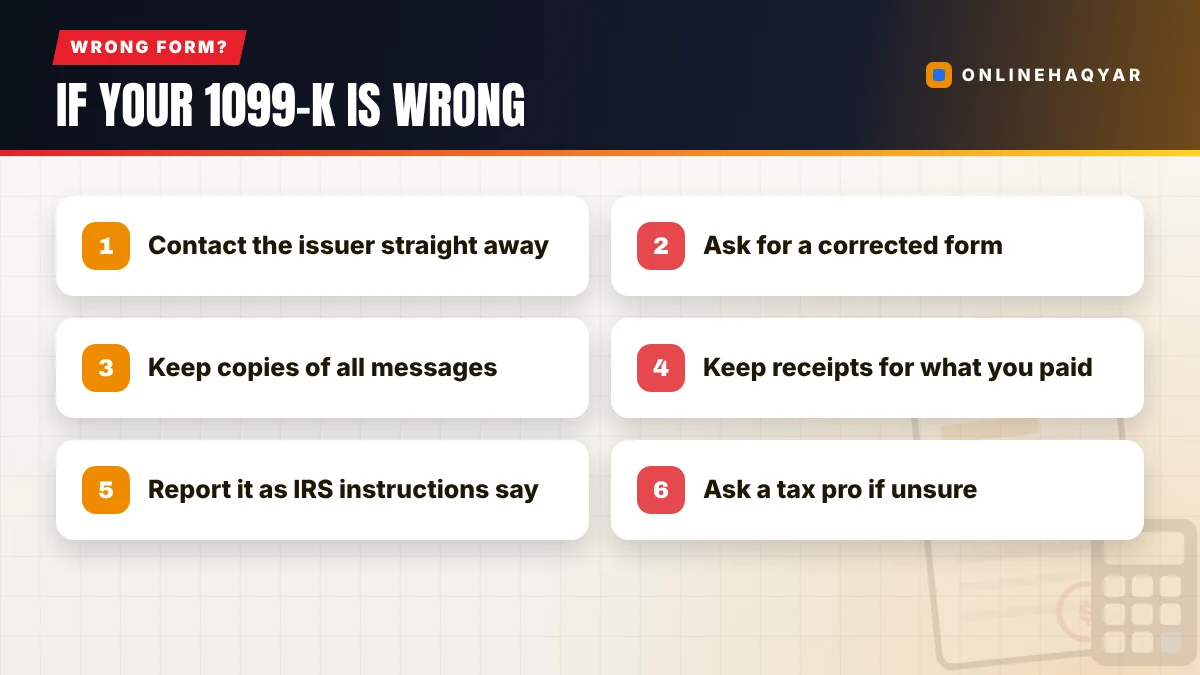
- Contact the issuer immediately. Its name and phone number are in the upper-left corner of the form.
- Keep copies of all correspondence.
- If you can’t get a corrected form, report the information as the IRS describes, using the entry space at the top of Schedule 1 (Form 1040) for tax years beginning in 2024.
Author’s tip: A wrong form is a paperwork problem, not proof that you owe tax. Stay calm, keep evidence of what each payment was for, and ask a tax professional if the amounts are large.
What about backup withholding?
Official source (IRS IR-2026-03, January 8, 2026): Treasury and the IRS issued proposed regulations under which payment platforms generally would not need to backup withhold unless payments to a payee exceed $20,000 and 200 transactions.
Author’s analysis: Those regulations were published as proposals for comment. We haven’t confirmed whether they have since been finalized, so check IRS.gov if a platform tells you it must withhold.
State rules may differ
Author’s analysis: The federal 1099-K threshold isn’t the only rule that can apply. Some states may have their own reporting rules for payment platforms, so check your state tax agency’s website if you sell regularly.
Watch for payment-app scams
Author’s tip: Tax season brings fake “IRS” messages about 1099-K forms and app payments. Never pay a “fee” to receive a form or a refund. If you’ve already sent money to someone you don’t trust, our guide on what to do if you paid a scammer explains the next steps by payment type. Self-employed and thinking about retirement savings? See our guide to the 2027 401(k) and IRA limits.
Frequently asked questions
What is the 1099-K threshold now?
For payment apps and online marketplaces, the 1099-K threshold is more than $20,000 in payments and more than 200 transactions in a calendar year.
Do I pay tax if I don’t get a 1099-K?
If it’s taxable income, yes. Staying under the 1099-K threshold doesn’t make income tax-free: the IRS says to report all income whether or not you receive a form.
Will a payment app report money my friends sent me for dinner?
Reimbursements and gifts should not be reported on a 1099-K. Ask friends to mark them as personal where the app allows it.
I sold my old couch for less than I paid. Do I owe tax?
A loss on a personal item isn’t deductible, and there’s no gain to tax. If you received a 1099-K that includes the sale, the IRS says the loss still needs to be reported on Schedule 1.
The bottom line
The $600 rule many people worried about is gone: the 1099-K threshold for payment apps and marketplaces is more than $20,000 and more than 200 transactions. But the tax law underneath didn’t move. Business income is still taxable, whatever the 1099-K threshold, and good records are still your best protection. Keep personal and business payments apart, track what you paid for things you sell, and check IRS.gov before you file.