
Last updated: November 2026. This article is general consumer information, not legal or tax advice. No affiliate links.
Giving Tuesday falls on Tuesday, December 1, 2026, the Tuesday after US Thanksgiving. It is one of the busiest days of the year for charity appeals, and that makes it a busy day for charity scams too. Inboxes, social feeds and phones fill up with requests, and most of them are genuine. A flood of urgent, emotional asks is exactly the setting a fake fundraiser needs, because people give quickly and check less.
You don’t need to stop giving. You need a short routine you can run in about five minutes before money leaves your account. This guide covers the warning signs, the five-minute check, the safest ways to pay, crowdfunding appeals, and where to report a fake charity in the US, Canada and the UK.
Why Giving Tuesday attracts charity scams
Author’s analysis: Three things line up on the same day. There is a high volume of legitimate requests, so a fake one blends in. Appeals are emotional by design, which discourages questions. And year-end deadlines (“our match ends at midnight!”) create urgency. None of these mean an appeal is fake. They mean it is worth slowing down for a few minutes.
Official guidance (US FTC): The Federal Trade Commission’s Giving Tuesday alert reminds donors that some dishonest telemarketers “use names that sound like well-known charities to confuse you.” (FTC consumer alert)
Warning signs of a fake charity
Official source (FTC, Donating Safely and Avoiding Scams): The FTC’s donor guide lists these red flags. (FTC: Donating safely)
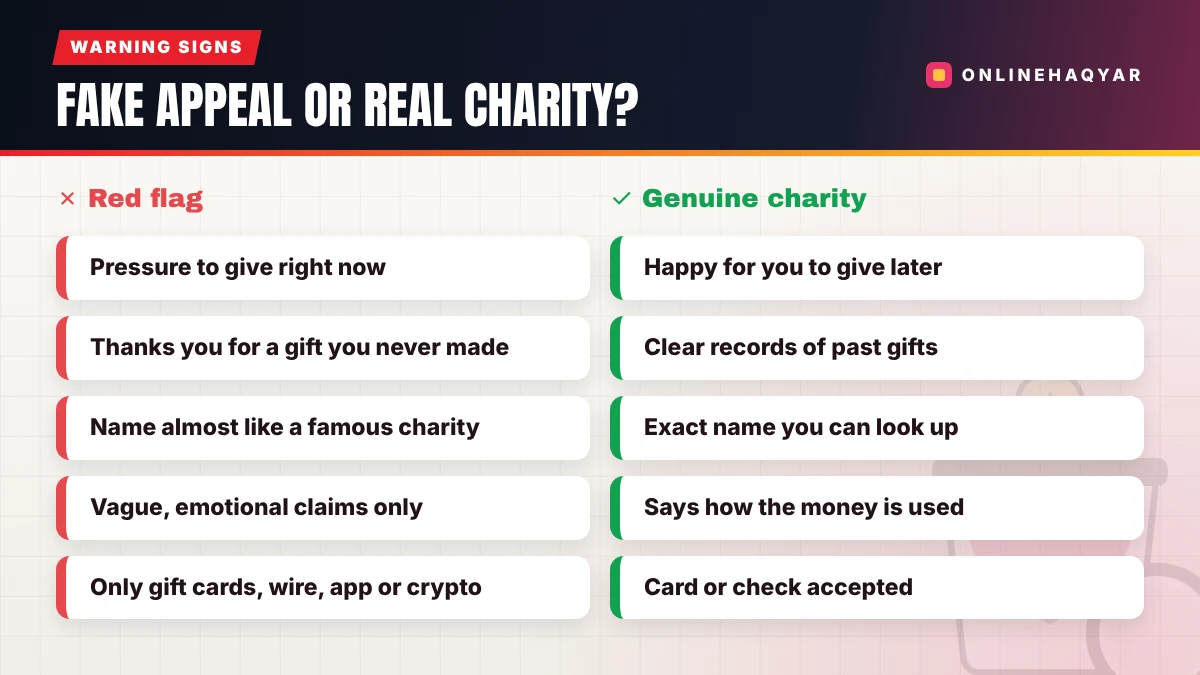
- Pressure to donate right away. The FTC puts it plainly: “Don’t let anyone rush you into making a donation.”
- Thanks for a donation you don’t remember making. It is a trick to make you feel you have already committed.
- Caller ID that looks local. Caller ID can be faked.
- A name that sounds like a well-known charity but isn’t quite the same.
- Vague, sentimental claims with no specifics about how the money will be used.
- Claims that your gift is tax-deductible when it isn’t.
- Guaranteed sweepstakes winnings in exchange for a donation. The FTC says this is not only a scam but illegal.
Author’s analysis: The most reliable red flag is the payment request. A real charity is glad to take your gift by card or check, next week if you prefer. Charity scams need the money now, and in a form that is hard to reverse.
The 5-minute charity check
Run these steps before you give to any organisation you haven’t supported before, or when an appeal arrives out of the blue. Most charity scams fall at step one or two.
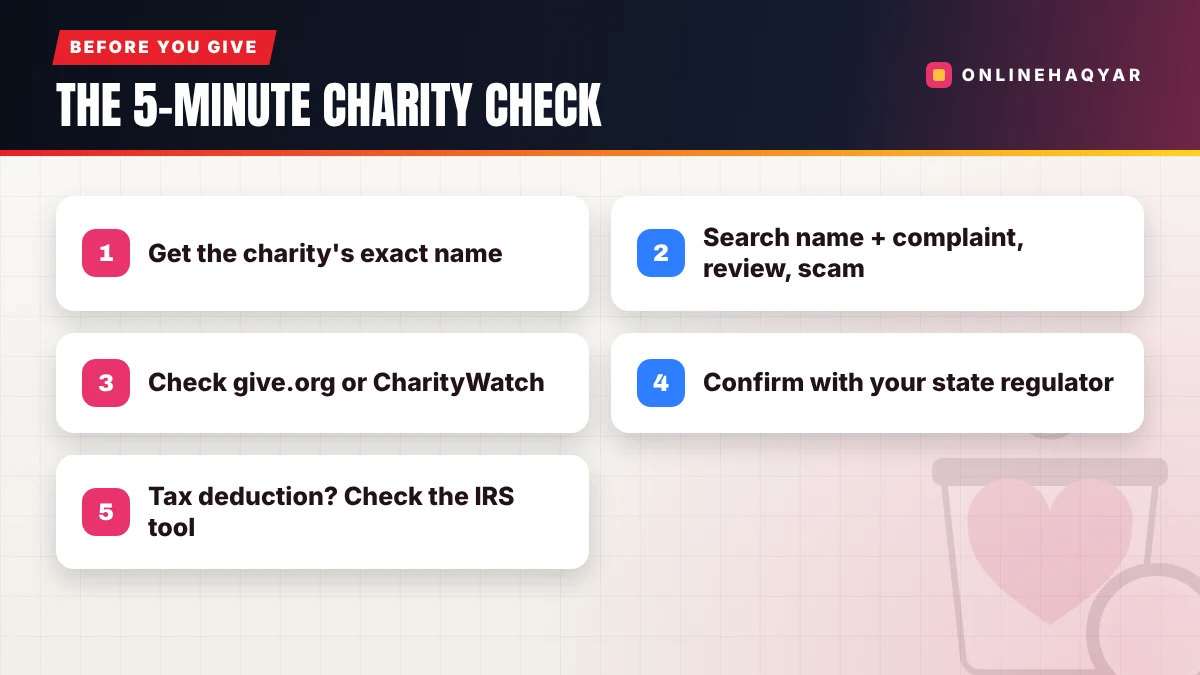
1. Get the exact name
Ask for the organisation’s full name and write it down. Look-alike names are a common trick, so “close enough” is not good enough. If a caller can’t or won’t spell it out, that tells you something.
2. Search the name with “complaint”, “review”, “rating” or “scam”
Official guidance (FTC): Searching the charity’s name together with words like these often surfaces problems quickly. Search the exact web address too, not just the name, because copycat pages can borrow a real charity’s name.
3. Check an independent evaluator
Official guidance (FTC): The FTC points donors to the BBB Wise Giving Alliance and CharityWatch, which publish reports and ratings on how charities operate and spend donations.
Author’s tip: A missing rating is not proof of a scam. Small and local charities often aren’t rated. In that case, lean harder on steps 4 and 5.
4. Check your state charity regulator
Official guidance (FTC): Your state charity regulator can tell you whether a charity is registered with it, which the FTC says is a requirement in most states. You can find your regulator through the National Association of State Charity Officials.
5. If you want a tax deduction, check the IRS
Official guidance (FTC): The IRS Tax Exempt Organization Search shows whether a donation to an organisation may be tax-deductible. Talk to a tax professional about your own situation.
Optional sixth step: The FTC also suggests calling the charity directly and asking how much of your donation will go to the programmes you care about. Use a phone number from the charity’s own website, not the one in the message.
Pay the safe way
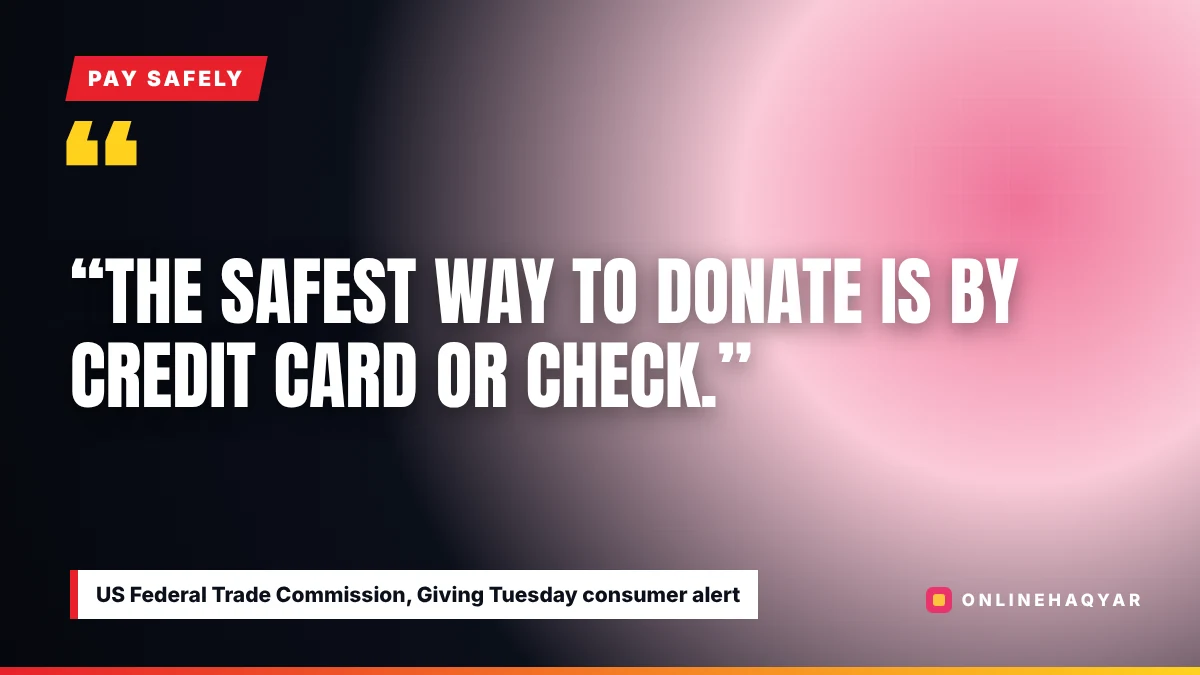
This is the single most useful rule. The FTC says: “The safest way to donate is by credit card or check.” It also warns that if someone says the only way to give is cryptocurrency, a payment app, a gift card or a wire transfer, it is likely a scam, not a real charity.
Official guidance (FTC): After you give, keep a record and check your statement. Make sure you were charged only the amount you agreed to, and that you weren’t signed up for a recurring donation you didn’t choose.
Author’s analysis: Card payments leave a trail and can usually be disputed. If something does go wrong, our guide on how to dispute a credit card charge explains the US process and deadlines. Anyone who asks for gift card codes is running a scam, full stop; our explainer on gift card scams shows why.
Crowdfunding and social-media appeals
A post shared by a friend isn’t proof the cause is real. Your friend may not know the organiser either. Charity scams can be shared in good faith by people who never checked them.
Official guidance (FTC): On crowdfunding pages, the money goes to the organiser, who may not be closely tied to the cause. Before you click a donation link, check who actually receives the money.
Author’s tip: If you want to help after a disaster or a personal tragedy you saw online, consider giving to an established organisation that is already working on it, and share that link instead of an unknown fundraiser. Be just as careful with “urgent” calls or voice messages that claim to be from someone you know; our guide to the AI voice-cloning family emergency scam explains that pattern.
Giving from Canada or the UK
Charity scams are not just a US problem. The checks are similar elsewhere, but the official registers are different.
Canada
Official source (Canada Revenue Agency): The CRA’s List of charities shows whether an organisation is registered, revoked, annulled, suspended or penalized, and includes contact details and financial information from the returns charities file. (CRA: How to get information about a charity)
United Kingdom
Official source (Charity Commission, Giving Tuesday 2025 press release): Donors are urged to check a charity’s name and registration number on the Charity Commission register and to look for the Fundraising Regulator’s badge. Most charities with an annual income of £5,000 or more must be registered. (GOV.UK press release)
The Charity Commission register covers England and Wales. Charities in Scotland and Northern Ireland are registered with their own regulators.
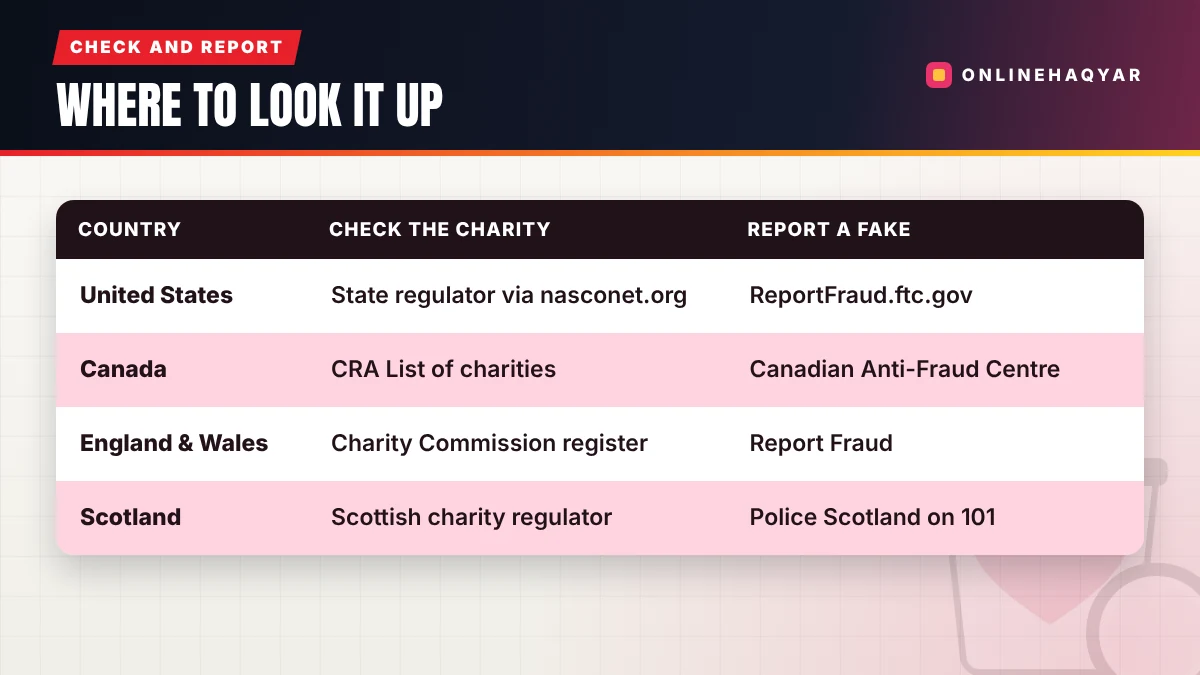
How to report charity scams
| Where you are | Where to report | Notes |
|---|---|---|
| United States | ReportFraud.ftc.gov | Also tell your state charity regulator |
| Canada | Canadian Anti-Fraud Centre | Online, or 1-888-495-8501; contact local police if you lost money |
| England, Wales, Northern Ireland | Report Fraud | Replaced Action Fraud from 4 December 2025; phone 0300 123 2040 |
| Scotland | Police Scotland | Call 101 |
Official guidance (FTC): When you report, include the organisation or fundraiser’s name, the phone number used and what you were told. Official source (GOV.UK): Report Fraud replaced Action Fraud as the national reporting service, and people in Scotland should keep calling Police Scotland on 101. For more detail, see our guide on how to report a scam in Canada and the UK.
Quick checklist to save
- Wrote down the charity’s exact name
- Searched it with “complaint”, “review” and “scam”
- Checked give.org, CharityWatch or my state regulator (or the CRA or Charity Commission)
- Called using a number from the charity’s own website, if unsure
- Paying by credit card or check, never gift card, wire or crypto
- Checked my statement afterwards for the right amount and no surprise recurring gift
Frequently asked questions
What is the safest way to donate to charity?
According to the FTC, by credit card or check. Be very wary if anyone insists on gift cards, wire transfers, cryptocurrency or payment apps.
How do I know if a charity is legitimate?
Get the exact name, search it with words like “complaint” and “scam”, check a rating site such as give.org or CharityWatch, and confirm registration with your state charity regulator. In Canada, use the CRA’s List of charities; in England and Wales, the Charity Commission register.
Is my donation tax-deductible?
In the US, check the IRS Tax Exempt Organization Search, then confirm with a tax professional. A fundraiser’s own claim is not enough.
Who do I tell about a fake charity appeal?
In the US, at ReportFraud.ftc.gov and to your state charity regulator. In Canada, the Canadian Anti-Fraud Centre. In England, Wales and Northern Ireland, Report Fraud; in Scotland, Police Scotland on 101.
The bottom line
Generosity and caution aren’t opposites. Before you give this Giving Tuesday, get the exact name, run a quick search, check a rating site or regulator, and pay by credit card or check. If anything feels rushed or vague, give to a different charity you can verify. Your money still does good, and charity scams get nothing.