
Last updated: November 2026. General information for Canadian residents, not financial or tax advice. Based on Canada Revenue Agency (CRA) pages read in November 2026. No affiliate links.
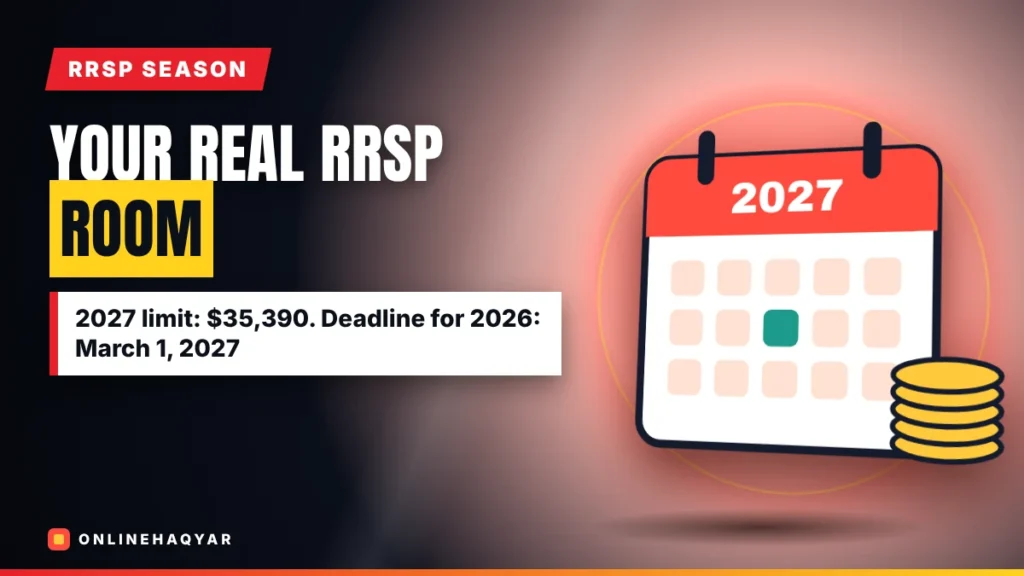
The Canada Revenue Agency has set the RRSP limit for 2027 at $35,390. But almost nobody can contribute exactly that amount. Your personal limit depends on last year’s earned income, any workplace pension and room you haven’t used yet.
Here’s how to find your real RRSP limit, why March 1, 2027 is the date to circle this RRSP season, and how to avoid the over-contribution tax.
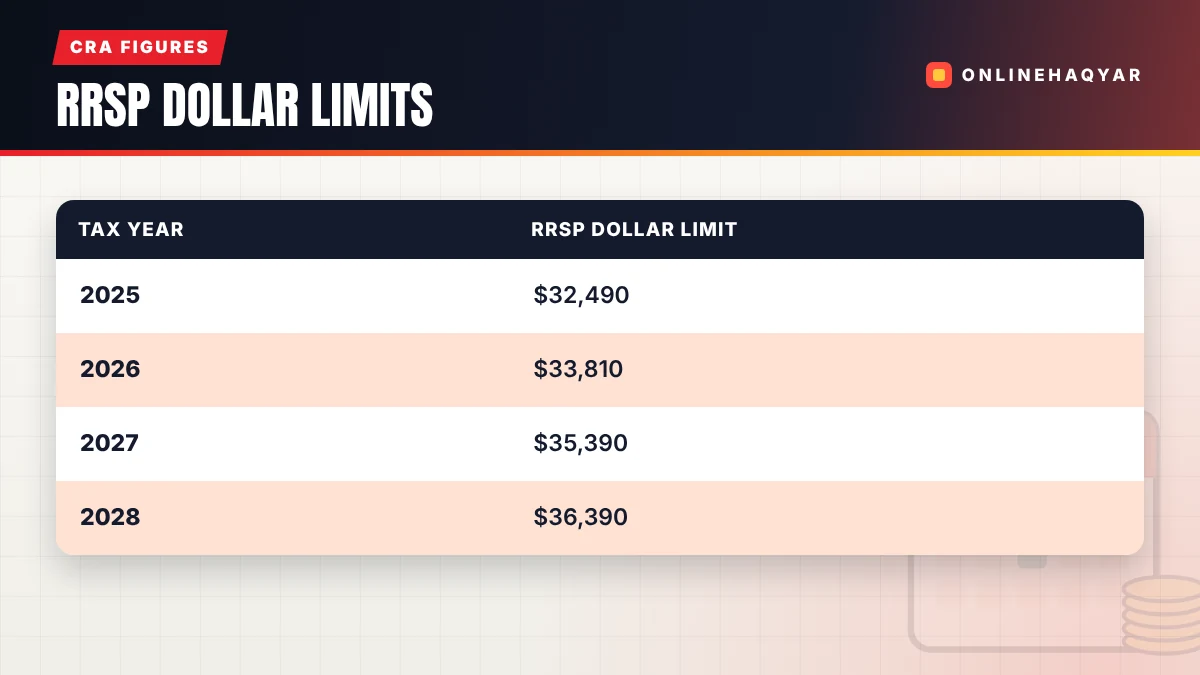
The RRSP limit for 2026, 2027 and 2028
Official source (CRA limits page, modified 2026-10-28): CRA publishes the yearly RRSP dollar limits on its limits and YMPE page.
| Tax year | RRSP dollar limit |
|---|---|
| 2025 | $32,490 |
| 2026 | $33,810 |
| 2027 | $35,390 |
| 2028 | $36,390 |
Official source (CRA “What’s new” page): CRA announced the new limits for 2027 and 2028 on October 28, 2026.
Author’s analysis: The dollar RRSP limit is a ceiling, not an allowance. It only matters if 18% of your earned income is higher than it, which works out at an income of roughly $196,600 for 2027 ($35,390 ÷ 0.18, our arithmetic).
Your RRSP limit isn’t the dollar limit: how room is calculated
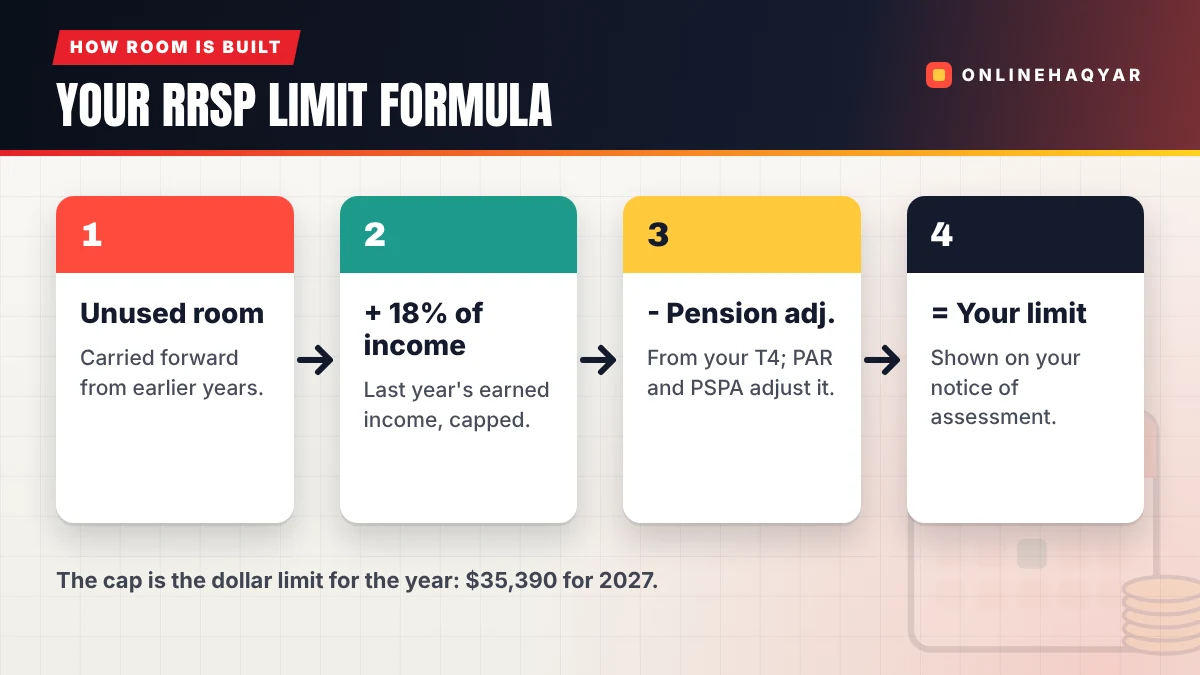
Official source (CRA, “How contributions affect your RRSP deduction limit”, modified 2026-11-17): In summary, your RRSP deduction limit for a year is:
Unused room carried forward from earlier years
+ the LESSER of: 18% of your earned income in the previous year
                 OR the annual dollar limit
- pension adjustment (PA) and certain other amounts
+ pension adjustment reversal (PAR), if any
- net past service pension adjustment (PSPA), if any
CRA defines the deduction limit as the maximum you can deduct for contributions to your own RRSPs, PRPP and SPP, and to your spouse’s or common-law partner’s RRSP or SPP, for a year. If you want to calculate it yourself, CRA points to chart 3 of Guide T4040.
Worked examples
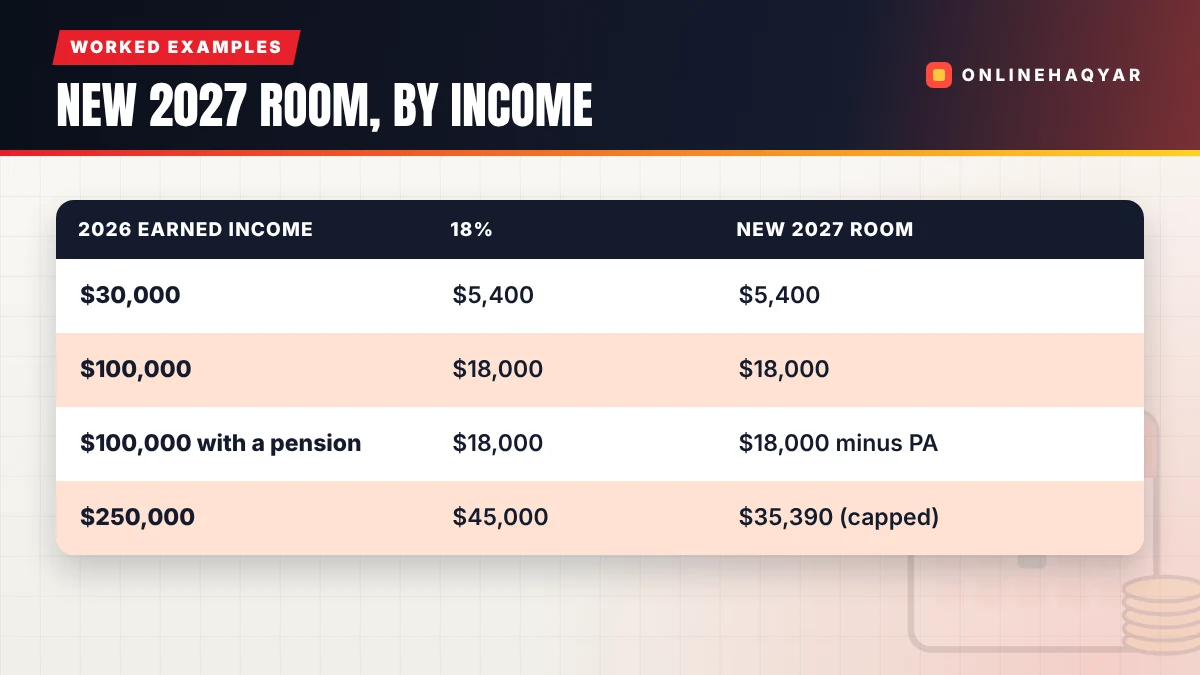
Author’s analysis (how the RRSP limit plays out for four people; our arithmetic, before any unused room):
- Priya, no workplace pension. Her 2026 earned income is $100,000. 18% is $18,000, which is lower than $35,390, so her new 2027 room is $18,000, plus any unused room.
- Daniel, high earner. His 2026 earned income is $250,000. 18% is $45,000, which is above the cap, so his new 2027 room is capped at $35,390, plus unused room.
- Aisha, workplace pension. Same income as Priya, but her T4 shows a pension adjustment. Her new room is $18,000 minus that PA. People in generous pension plans may have little RRSP room at all.
- Sam, part-time. His 2026 earned income is $30,000, so his new room is $5,400.
Author’s opinion: Don’t calculate from scratch if you can avoid it. CRA’s own pages refer to the RRSP deduction limit shown on your latest notice of assessment or reassessment, and that figure already accounts for pension adjustments.
The 2026 deadline: March 1, 2027
Official source (CRA): CRA’s page gives March 1, 2027 as the last date for contributions that qualify for the 2026 tax year.
Author’s analysis: Contributions made in January and February 2027 can count toward your 2026 return. Make sure your institution records the contribution date correctly, and don’t leave it to the last afternoon: transfers between institutions can take days.
Author’s tip: You don’t have to deduct a contribution in the year you make it. If you expect a higher income next year, you can contribute now and carry the deduction forward. Ask a tax professional whether that suits you.
Over-contributing: the $2,000 buffer and the 1% tax
Official source (CRA): Generally, you pay a tax of “1 percent per month” on contributions that exceed your RRSP deduction limit “by more than $2,000.”
Official source (CRA, “Determine if you have to complete a T1-OVP”): You don’t have to file a T1-OVP return if your unused contributions are less than your deduction limit from your latest notice of assessment or reassessment “plus $2,000”. If you do owe the tax, CRA asks you to “send documents that identify the exact months of all RRSP, PRPP, and SPP contributions”, because “RRSP receipts, T4RSP and T4RIF slips do not contain this information.”
Author’s analysis: The $2,000 cushion is there for mistakes, not as a strategy. If you discover an excess, act quickly, because the tax runs monthly. Keep your own record of the month of every contribution.
Age 71 and spousal RRSPs
Official source (CRA): You can contribute to your own RRSP “until December 31st of the year you turn 71 years of age,” and to your spouse’s or common-law partner’s RRSP until December 31 of the year they turn 71.
Official guidance (CRA, “Withdrawing from spousal or common-law partner RRSPs”): If your spouse or partner withdraws from a spousal RRSP, you “will probably have to include in your income” the amount withdrawn if you contributed to any of their RRSPs in the year of the withdrawal “or in either of the two preceding years.” Read the CRA spousal RRSP withdrawal page for the details.
Author’s analysis: Contributions to a spousal RRSP use your deduction limit, not your partner’s. Plan withdrawals around the three-year window above.
Your RRSP-season checklist
Author’s opinion:
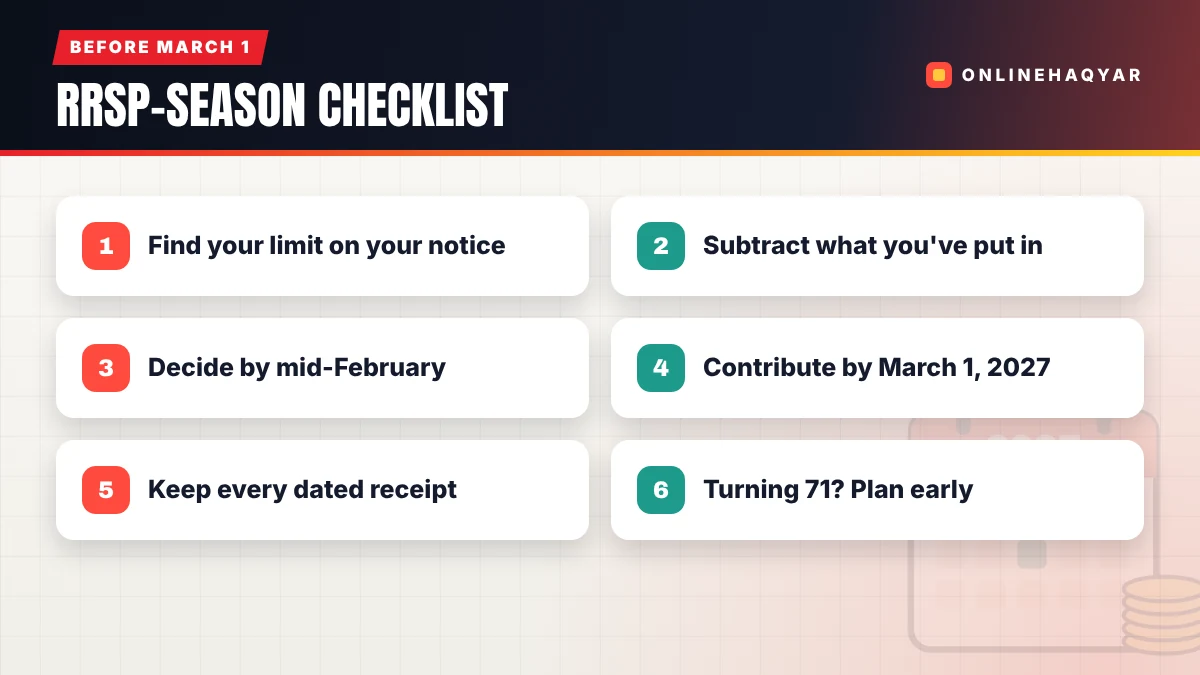
- Find your personal RRSP limit (your deduction limit) on your latest notice of assessment.
- Subtract anything you’ve already contributed for 2026, including January and February 2027 contributions.
- Decide by mid-February whether to contribute and how much.
- Make your contribution by March 1, 2027 for the 2026 tax year.
- Keep every contribution receipt with its date.
- Turning 71 in 2027? It’s your last year to contribute to your own RRSP, so plan your options early.
Your payslip is changing in 2027 too: read our guide to the CPP contribution rate cut in 2027. Cross-border readers can compare US figures in our guide to 2027 401(k) and IRA limits, and self-employed readers may find our freelance invoice guide useful for keeping income records.
Frequently asked questions
What is the RRSP limit for 2027?
$35,390, according to CRA. For 2026 it is $33,810, and for 2028 it will be $36,390.
What is the RRSP deadline for the 2026 tax year?
March 1, 2027. That is the last day to make a contribution that counts toward the 2026 tax year, and it should stay within your RRSP limit.
How is my RRSP room calculated?
Your RRSP limit is generally 18% of your previous year’s earned income, up to the annual dollar limit, minus your pension adjustment, plus unused room carried forward.
What happens if I over-contribute?
A tax of 1% per month generally applies to contributions that exceed your deduction limit by more than $2,000.
Until what age can I contribute?
Until December 31 of the year you turn 71.
The bottom line
The 2027 RRSP limit is $35,390, but your real room is 18% of last year’s earned income up to that cap, minus any pension adjustment, plus unused room. For the 2026 tax year, the last day to contribute is March 1, 2027. Check your notice of assessment, stay inside the $2,000 buffer, and you’ll avoid the most common RRSP mistakes.